How ancient Egyptians made and used perfume
Ancient Egyptians made perfume on a base of vegetable oil or animal fat, not alcohol, and also released scent by burning incense such as kyphi. They drew scent from plants by maceration and boiling. Perfumed oils anointed the image of the god in temples, kings gave perfume as a reward, and perfume played a major part in funerary beliefs.
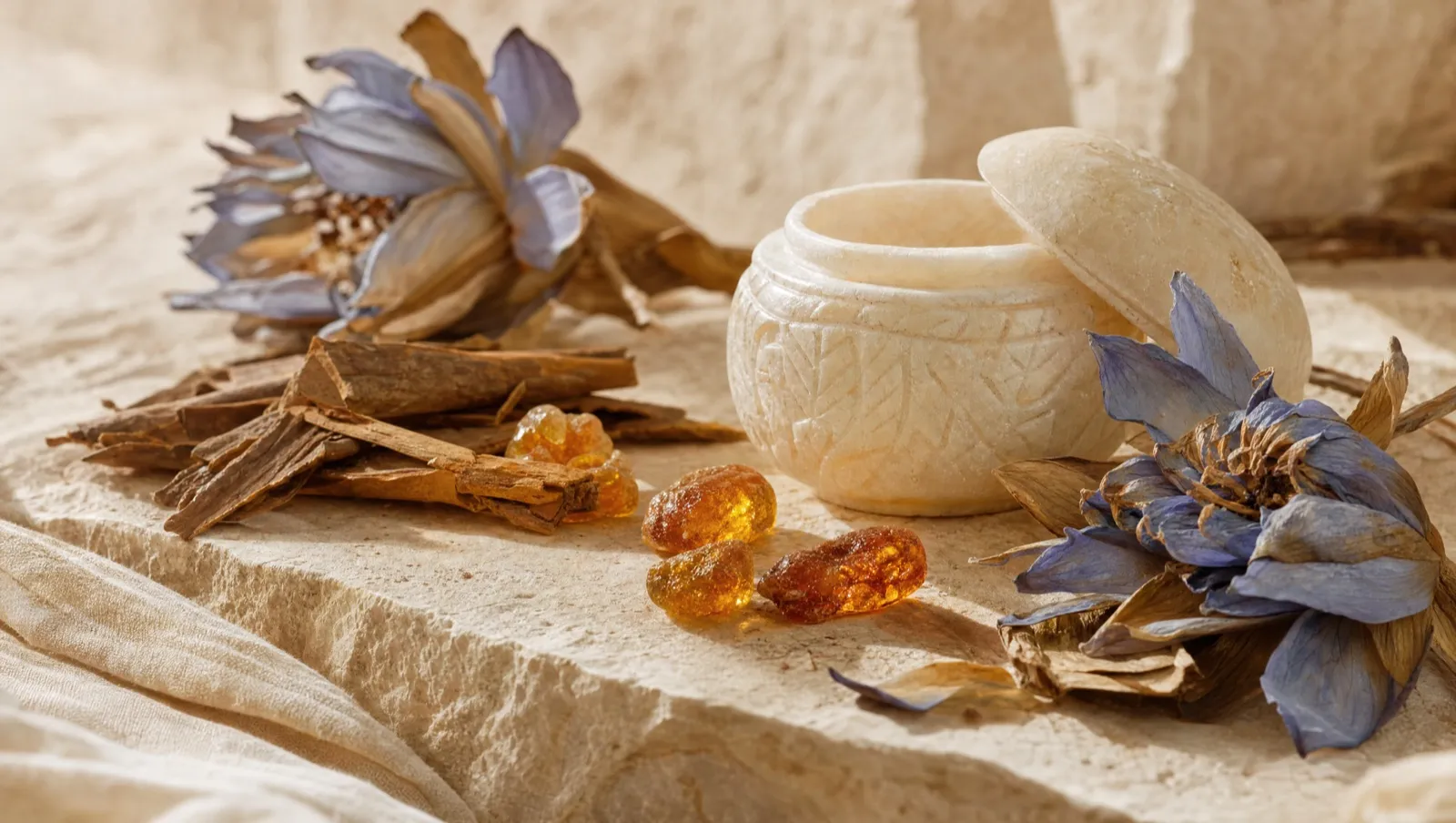
Ancient Egyptian perfume had no alcohol in it: the base was vegetable oil or animal fat.[1] Scent was also released by burning incense.[2]
Oils, fats and slow work
Base oils included local sesame, castor, balanos and moringa, with fat of ox, sheep or fowl for a more solid unguent.[3] Egyptians drew scent from plants by maceration and boiling, and the ingredient added last was the most pungent.[4]
Most preparation details come from the walls of the so-called laboratory in the Ptolemaic temple of Edfu.[5] The whole operation could take up to a year, or two if preparing the base was included.[6]
Kyphi, the scent to be smoked
Kyphi is the Greek form of the Egyptian kapet, a substance to be smoked, known from temple walls at Edfu and Philae and from the Ebers papyrus.[7] It has about 16 ingredients, resins, herbs and spices on a base of raisins; the Ebers recipe has fewer.[8]
A 2021 study notes that the Ebers mixture was ground and burned to scent the home and perfume clothing, and was even used as chewing gum.[9] Plutarch wrote that resin and myrrh were burned by day and kyphi was offered at nightfall.[10] Lise Manniche writes in the UCLA Encyclopedia of Egyptology that any claim to authenticity for modern kyphi would stumble over lexicographical hurdles.[11]
Myrrh from Punt
Frankincense and myrrh traditionally came from the land of Punt, in the area of Eritrea and Somalia.[12]
Reliefs in the temple at Deir el-Bahari record an expedition of Queen Hatshepsut to Punt, completed just before her ninth year.[13][14][15] In James Henry Breasted’s translation, the ships are loaded with fragrant woods, heaps of myrrh-resin and fresh myrrh trees.[16] Where the myrrh is measured for the god Amon, the text says of Hatshepsut that “the best of myrrh is upon all her limbs”.[15][17][18]
The Mendesian, rebuilt
Pliny the Elder described the Mendesian as balanus oil with resin and myrrh, to which makers of his day also added metopion, an Egyptian oil from bitter almonds.[19] Greco-Roman sources consistently list balanos oil, myrrh, cassia and resin, but no Egyptian source gives a recipe.[20][21]
Only the 7th-century physician Paul of Aegina records both quantities and method.[22] In his recipe, the dry ingredients are stirred into the oil for 60 days; then pine resin is added and the mix is stirred for 7 more days.[23]
In 2018 and 2019, two of the study’s authors, Goldsmith and Coughlin, tested this cold method and a warm one, made in a bain-marie or on a low fire.[24][25] One version, the study reports, was extremely pleasant, with a spicy base of freshly ground myrrh and cinnamon and some sweetness.[26]
At Tell Timai, excavators found what was likely a fragrance workshop and took residue samples from its amphorae for analysis.[27][28]
Temples, tombs and head cones
Perfumed oils or fats anointed the image of the god in the daily temple ritual.[29] Kings also gave perfume to worthy officials as a reward.[30] Perfume also played a major part in funerary beliefs.[31] In Tutankhamun’s tomb, robbers brought leather skins to remove the oils, and some jars still bear their fingerprints.[31]
Banquet scenes in tombs show guests with cones on their heads, which Manniche reads as the artist’s sign that they were heavily perfumed.[32] In 2019, Anna Stevens and colleagues reported the first real head cones, from the Amarna cemeteries.[33][34] Their main component was a biological wax, not fat or incense, and the authors tentatively read them as symbols of rebirth or fertility in the afterlife.[34][35] Science News reported that no fat traces or perfume were found, and Stevens said any perfume had likely evaporated.[36]
What residues show
Most available analyses of perfume jar contents are antiquated and report only “fatty matter”, Manniche writes.[37] Pollen from the mummy of Ramesses II showed his body had been anointed with chamomile oil.[38]
A 2023 study of balm from the canopic jars of the noble lady Senetnay, from around 1450 BCE, found beeswax, plant oil, fats, bitumen, Pinaceae resins, a balsamic substance and dammar or Pistacia resin.[39] These were embalming balms, not perfume, but the authors found odorous ingredients in them.[40] Coumarin, which has a vanilla-like scent, was among the compounds detected.[41][42]
Questions
What was ancient Egyptian perfume made of?
The base was vegetable oil or animal fat, not alcohol. Base oils included sesame, castor, balanos and moringa, and fat of ox, sheep or fowl made a more solid unguent. Scent was drawn from plants by maceration and boiling.
What is kyphi?
Kyphi is the Greek form of the Egyptian kapet, a substance to be smoked. It has about 16 ingredients, resins, herbs and spices on a base of raisins. The earliest recipe, in the Ebers papyrus, has fewer and was ground, mixed and burned.
Did Egyptians really wear perfume cones on their heads?
Tomb scenes show guests with cones on their heads, which Lise Manniche reads as the artist's sign that they were heavily perfumed. In 2019, archaeologists reported the first real head cones, from the Amarna cemeteries. Their main component was a biological wax, not fat or incense.
Sources
- Eau de Cleopatra: Mendesian Perfume and Tell Timai, Near Eastern Archaeology, 2021. DOI: 10.1086/715345.
- Perfume (UCLA Encyclopedia of Egyptology), UCLA Encyclopedia of Egyptology, 2009.
- Perfume (UCLA Encyclopedia of Egyptology), UCLA Encyclopedia of Egyptology, 2009.
- Perfume (UCLA Encyclopedia of Egyptology), UCLA Encyclopedia of Egyptology, 2009.
- Perfume (UCLA Encyclopedia of Egyptology), UCLA Encyclopedia of Egyptology, 2009.
- Perfume (UCLA Encyclopedia of Egyptology), UCLA Encyclopedia of Egyptology, 2009.
- Perfume (UCLA Encyclopedia of Egyptology), UCLA Encyclopedia of Egyptology, 2009.
- Perfume (UCLA Encyclopedia of Egyptology), UCLA Encyclopedia of Egyptology, 2009.
- Eau de Cleopatra: Mendesian Perfume and Tell Timai, Near Eastern Archaeology, 2021. DOI: 10.1086/715345.
- Isis and Osiris (Moralia), tr. F. C. Babbitt, LacusCurtius (University of Chicago).
- Perfume (UCLA Encyclopedia of Egyptology), UCLA Encyclopedia of Egyptology, 2009.
- Perfume (UCLA Encyclopedia of Egyptology), UCLA Encyclopedia of Egyptology, 2009.
- Ancient Records of Egypt, vol. 2: The Eighteenth Dynasty (James Henry Breasted), University of Chicago Press, 1906.
- Ancient Records of Egypt, vol. 2: The Eighteenth Dynasty (James Henry Breasted), University of Chicago Press, 1906.
- Ancient Records of Egypt, vol. 2: The Eighteenth Dynasty (James Henry Breasted), University of Chicago Press, 1906.
- Ancient Records of Egypt, vol. 2: The Eighteenth Dynasty (James Henry Breasted), University of Chicago Press, 1906.
- Ancient Records of Egypt, vol. 2: The Eighteenth Dynasty (James Henry Breasted), University of Chicago Press, 1906.
- Ancient Records of Egypt, vol. 2: The Eighteenth Dynasty (James Henry Breasted), University of Chicago Press, 1906.
- The Natural History, Book 13, chapter 2 (Pliny the Elder, tr. Bostock and Riley), Perseus Digital Library (Tufts University).
- Eau de Cleopatra: Mendesian Perfume and Tell Timai, Near Eastern Archaeology, 2021. DOI: 10.1086/715345.
- Eau de Cleopatra: Mendesian Perfume and Tell Timai, Near Eastern Archaeology, 2021. DOI: 10.1086/715345.
- Eau de Cleopatra: Mendesian Perfume and Tell Timai, Near Eastern Archaeology, 2021. DOI: 10.1086/715345.
- Eau de Cleopatra: Mendesian Perfume and Tell Timai, Near Eastern Archaeology, 2021. DOI: 10.1086/715345.
- Eau de Cleopatra: Mendesian Perfume and Tell Timai, Near Eastern Archaeology, 2021. DOI: 10.1086/715345.
- Eau de Cleopatra: Mendesian Perfume and Tell Timai, Near Eastern Archaeology, 2021. DOI: 10.1086/715345.
- Eau de Cleopatra: Mendesian Perfume and Tell Timai, Near Eastern Archaeology, 2021. DOI: 10.1086/715345.
- Eau de Cleopatra: Mendesian Perfume and Tell Timai, Near Eastern Archaeology, 2021. DOI: 10.1086/715345.
- Eau de Cleopatra: Mendesian Perfume and Tell Timai, Near Eastern Archaeology, 2021. DOI: 10.1086/715345.
- Perfume (UCLA Encyclopedia of Egyptology), UCLA Encyclopedia of Egyptology, 2009.
- Perfume (UCLA Encyclopedia of Egyptology), UCLA Encyclopedia of Egyptology, 2009.
- Perfume (UCLA Encyclopedia of Egyptology), UCLA Encyclopedia of Egyptology, 2009.
- Perfume (UCLA Encyclopedia of Egyptology), UCLA Encyclopedia of Egyptology, 2009.
- Archaeologists have finally found ancient Egyptian wax head cones, Science News, 2019.
- From representation to reality: ancient Egyptian wax head cones from Amarna, Antiquity, 2019. DOI: 10.15184/aqy.2019.175.
- From representation to reality: ancient Egyptian wax head cones from Amarna, Antiquity, 2019. DOI: 10.15184/aqy.2019.175.
- Archaeologists have finally found ancient Egyptian wax head cones, Science News, 2019.
- Perfume (UCLA Encyclopedia of Egyptology), UCLA Encyclopedia of Egyptology, 2009.
- Perfume (UCLA Encyclopedia of Egyptology), UCLA Encyclopedia of Egyptology, 2009.
- Biomolecular characterization of 3500-year-old ancient Egyptian mummification balms from the Valley of the Kings, Scientific Reports, 2023. DOI: 10.1038/s41598-023-39393-y.
- Biomolecular characterization of 3500-year-old ancient Egyptian mummification balms from the Valley of the Kings, Scientific Reports, 2023. DOI: 10.1038/s41598-023-39393-y.
- Biomolecular characterization of 3500-year-old ancient Egyptian mummification balms from the Valley of the Kings, Scientific Reports, 2023. DOI: 10.1038/s41598-023-39393-y.
- Biomolecular characterization of 3500-year-old ancient Egyptian mummification balms from the Valley of the Kings, Scientific Reports, 2023. DOI: 10.1038/s41598-023-39393-y.