Arabic perfume: oud, bakhoor, layering and al-Kindī's recipes
A Swiss Arabian Perfumes executive describes Arabian perfume as richer and deeper, with oud, amber, musk and saffron as a base. Abdulla Ajmal of Ajmal Dubai says it was built around intensity, layering and atmosphere. In the Gulf, perfume is rarely worn as a single product: bakhoor smoke, oud oil and a sprayed perfume may be layered.
Ammar Nabeel Adam Ali of Swiss Arabian Perfumes told Gulf News in 2026 that Arabian fragrances are generally different in their richness and depth.[1] In the 9th century, the philosopher al-Kindī wrote a book of 107 perfume recipes.[13][15][17]
What sets Arabian perfume apart
Ali said Arabian fragrances tend to use oud, amber, musk and saffron as a base.[1]
Abdulla Ajmal, CEO of Ajmal Dubai, told the same paper that Arabian perfumery was built around intensity, layering and atmosphere.[2][3] Western perfumery, he said, historically evolved around freshness, structure and seasonal wearability.[2]
In 2014, Abdulla Ajmal, then general manager of Ajmal Perfumes, told Khaleej Times that fragrances for the local consumer are created to leave behind a trail.[4]
Oud, bakhoor and attar
Ajmal told Gulf News that in his part of the world, people do not discover oud through perfumery but grow up around it.[5] He said you smell it in homes before guests arrive, in clothing, during celebrations and in prayer spaces.[5]
Khaleej Times wrote in 2014 that the scent of agarwood indicates wealth, esteem and Arab culture.[6] Abdur Rahim Ajmal, head of the oud division at Ajmal Perfumes, told the paper it is a sign of esteem, power and affluence, found in most Arab houses.[7]
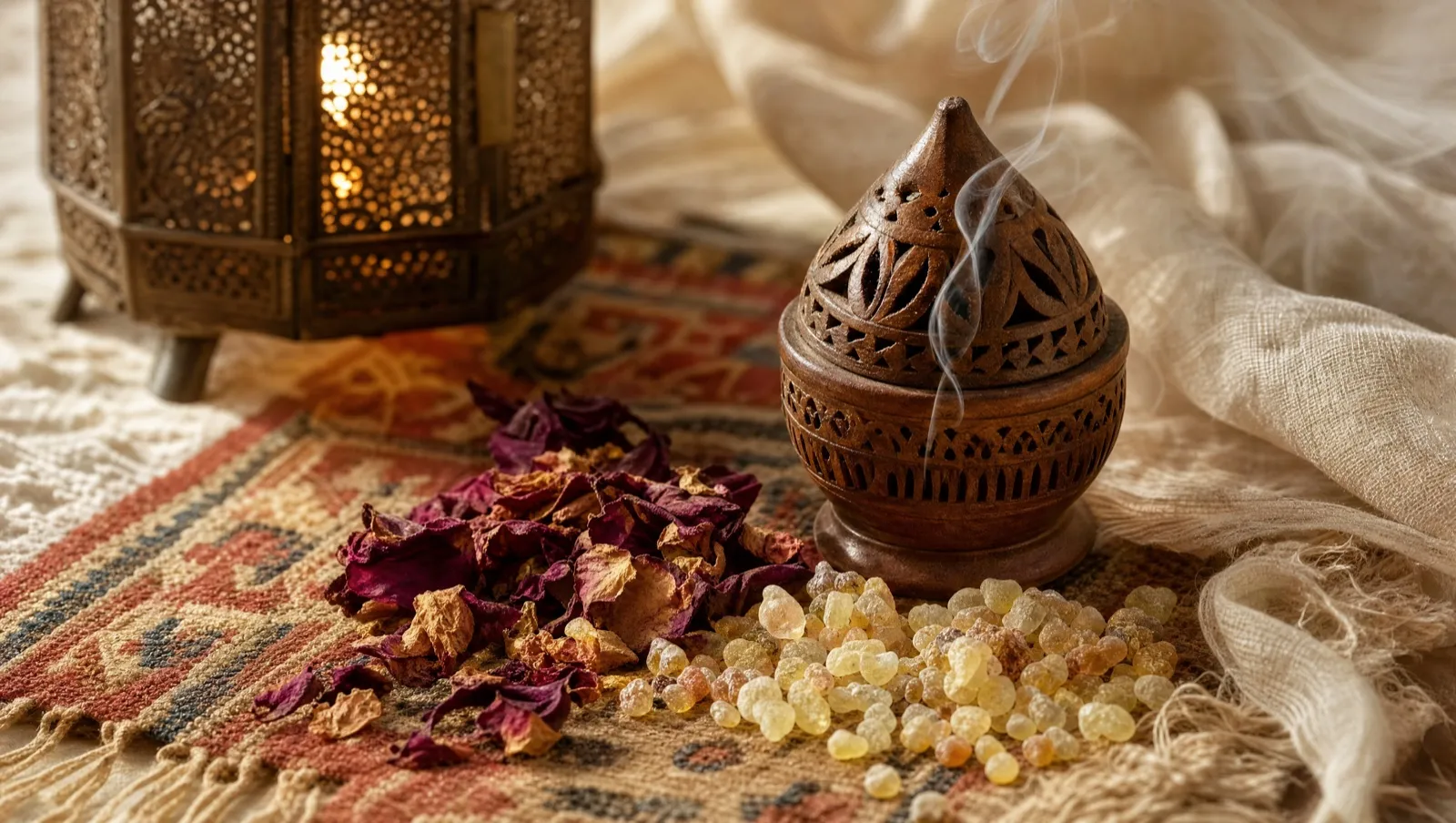
Gulf News spells it both bukhoor and bakhoor.[8][12] It writes that for generations bukhoor has been part of preparing an Emirati home for guests, with a mabkhara moving from room to room and leaving a trail of fragrant smoke.[8] Someone chooses the blend, places it over the coal and carries the mabkhara around the house.[9] Its smoke settles into the majlis cushions, the curtains and the clothes of the people sitting there.[8]
National Geographic reported in 2020 that most attar from Kannauj now ends up in the Middle East and among regional Muslim communities in India.[10]
How perfume is layered in the Gulf
Gulf News reports that layering remains central in the UAE and the wider Gulf, where perfume is rarely worn as a single product.[11] People may first burn bakhoor into their clothing and hair.[12] Next comes oud oil, or dehn el oud, on the pulse points, and a final perfume is sprayed over it.[12]
Al-Kindī’s book of perfume
Al-Kindī is recognized as a philosopher who established the basic learning of ancient sciences, including Greek philosophy, in the Islamic world.[13] Sabra, quoted in a 2017 paper by Takatomo Inoue, placed his educational project in the 9th century.[14]
His perfume book is Kitāb Kīmiyāʾ al-ʿIṭr wa-’l-Taṣʿīdāt.[17] Karl Garbers published a German translation in Leipzig in 1948, as Buch über die Chemie des Parfüms und die Destillationen.[15][16]
The book contains 107 perfume recipes in three groups.[17] The first covers replacements for particular drugs, or drug counterfeiting; the second, fragrant oils and ointments; the third, the distillation of aromatic waters.[18] Twenty-eight recipes need distillation.[19] For these distillation recipes, the main ingredients include camphor, citron, saffron, musk, agarwood (ʿūd), sandalwood, rose and jasmine.[20]
Inoue writes that the book deals only with methods of preparing perfume and discusses no alchemical theory.[21] Al-Kindī adds colors to rose water during distillation.[22] Even so, Inoue finds his method almost identical to the one in alchemical texts in its instruments, processes and technology.[22]
Rose water and distillation
The encyclopedic handbook Mafātīḥ al-ʿUlūm, by Aḥmad ibn Yūsuf al-Khwārizmī, calls the cucurbit and the alembic the instruments of the rose water maker.[23]
Historian Ahmad Y. al-Hassan cites Forbes, a historian of technology, who said a technique for distilling essential oils developed only with the golden age of Arab culture.[24] By distilling the rose, al-Hassan writes, the Arabs extracted rose water.[24] Damascus was famous for its rose water, which was exported to several countries, including in Europe.[25]
The Gulf market today
The Gulf Cooperation Council (GCC) is made up of Bahrain, Kuwait, Oman, Qatar, Saudi Arabia and the United Arab Emirates.[26] BeautyMatter, citing Euromonitor International, valued Saudi Arabia’s fragrance market at $2.9 billion in 2025, the highest-value fragrance category in the GCC.[27] Across the 6 countries, beauty and personal care was worth $14.3 billion in 2025, with $18.9 billion forecast for 2030.[28]
According to Mintel, fragrance is the most-used beauty and personal care category in Saudi Arabia.[29] Interest is growing abroad: in the US, searches, views and posts related to Arabian perfume rose 48% year over year, according to Spate data cited by BeautyMatter.[30]
Questions
What is bakhoor?
Gulf News, which spells it both bukhoor and bakhoor, describes a blend placed over the coal, with the mabkhara carried from room to room, leaving a trail of fragrant smoke. The smell settles into cushions, curtains and clothes, and for generations it has been part of preparing an Emirati home for guests.
How is Arabic perfume layered?
Gulf News reports that in the Gulf, perfume is rarely worn as a single product. People may first burn bakhoor into clothing and hair, then apply oud oil to the pulse points and spray a final perfume over it.
What did al-Kindī write about perfume?
His book Kitāb Kīmiyāʾ al-ʿIṭr wa-’l-Taṣʿīdāt contains 107 perfume recipes in three groups: replacements for particular drugs or drug counterfeits, fragrant oils and ointments, and the distillation of aromatic waters. Karl Garbers published a German translation in Leipzig in 1948.
Sources
- Why the UAE is the world’s perfume capital: Inside its rich oud and scent heritage, Gulf News, 2026.
- Why the UAE is the world’s perfume capital: Inside its rich oud and scent heritage, Gulf News, 2026.
- Why the UAE is the world’s perfume capital: Inside its rich oud and scent heritage, Gulf News, 2026.
- Fragrances: A way of life in the Middle East, Khaleej Times, 2014.
- Why the UAE is the world’s perfume capital: Inside its rich oud and scent heritage, Gulf News, 2026.
- Fragrances: A way of life in the Middle East, Khaleej Times, 2014.
- Fragrances: A way of life in the Middle East, Khaleej Times, 2014.
- The Emirati ‘house smells’: why oud, bukhoor and gahwa can never be replaced, Gulf News, 2026.
- The Emirati ‘house smells’: why oud, bukhoor and gahwa can never be replaced, Gulf News, 2026.
- How did Kannauj become a perfume capital, National Geographic, 2020.
- Why the UAE is the world’s perfume capital: Inside its rich oud and scent heritage, Gulf News, 2026.
- Why the UAE is the world’s perfume capital: Inside its rich oud and scent heritage, Gulf News, 2026.
- Al-Kindī’s Attack on Alchemy and His Perfume Making, ORIENT (The Society for Near Eastern Studies in Japan), 2017. DOI: 10.5356/orient.52.72.
- Al-Kindī’s Attack on Alchemy and His Perfume Making, ORIENT (The Society for Near Eastern Studies in Japan), 2017. DOI: 10.5356/orient.52.72.
- Kitāb kīmiyāʼ al-ʻiṭr wat-taṣʻīdāt (catalogue record), Wellcome Collection, 1948.
- Kitāb kīmiyāʼ al-ʻiṭr wat-taṣʻīdāt (catalogue record), Wellcome Collection, 1948.
- Al-Kindī’s Attack on Alchemy and His Perfume Making, ORIENT (The Society for Near Eastern Studies in Japan), 2017. DOI: 10.5356/orient.52.72.
- Al-Kindī’s Attack on Alchemy and His Perfume Making, ORIENT (The Society for Near Eastern Studies in Japan), 2017. DOI: 10.5356/orient.52.72.
- Al-Kindī’s Attack on Alchemy and His Perfume Making, ORIENT (The Society for Near Eastern Studies in Japan), 2017. DOI: 10.5356/orient.52.72.
- Al-Kindī’s Attack on Alchemy and His Perfume Making, ORIENT (The Society for Near Eastern Studies in Japan), 2017. DOI: 10.5356/orient.52.72.
- Al-Kindī’s Attack on Alchemy and His Perfume Making, ORIENT (The Society for Near Eastern Studies in Japan), 2017. DOI: 10.5356/orient.52.72.
- Al-Kindī’s Attack on Alchemy and His Perfume Making, ORIENT (The Society for Near Eastern Studies in Japan), 2017. DOI: 10.5356/orient.52.72.
- Al-Kindī’s Attack on Alchemy and His Perfume Making, ORIENT (The Society for Near Eastern Studies in Japan), 2017. DOI: 10.5356/orient.52.72.
- Transfer of Islamic Technology to the West: Technology Transfer in the Chemical Industries, History of Science and Technology in Islam (Ahmad Y. al-Hassan).
- Transfer of Islamic Technology to the West: Technology Transfer in the Chemical Industries, History of Science and Technology in Islam (Ahmad Y. al-Hassan).
- GCC Beauty Market to Reach $18.9 Billion by 2030, BeautyMatter, 2026.
- GCC Beauty Market to Reach $18.9 Billion by 2030, BeautyMatter, 2026.
- GCC Beauty Market to Reach $18.9 Billion by 2030, BeautyMatter, 2026.
- GCC Beauty Market to Reach $18.9 Billion by 2030, BeautyMatter, 2026.
- GCC Beauty Market to Reach $18.9 Billion by 2030, BeautyMatter, 2026.