What does amber mean in perfume?
In perfume, amber has nothing to do with the fossil resin used in jewelry. The word began as a short form of ambergris, and today an amber note is usually built from labdanum combined with styrax, vanilla, civet or benzoin. Fragrances of the World now also uses Amber for the family once called oriental.
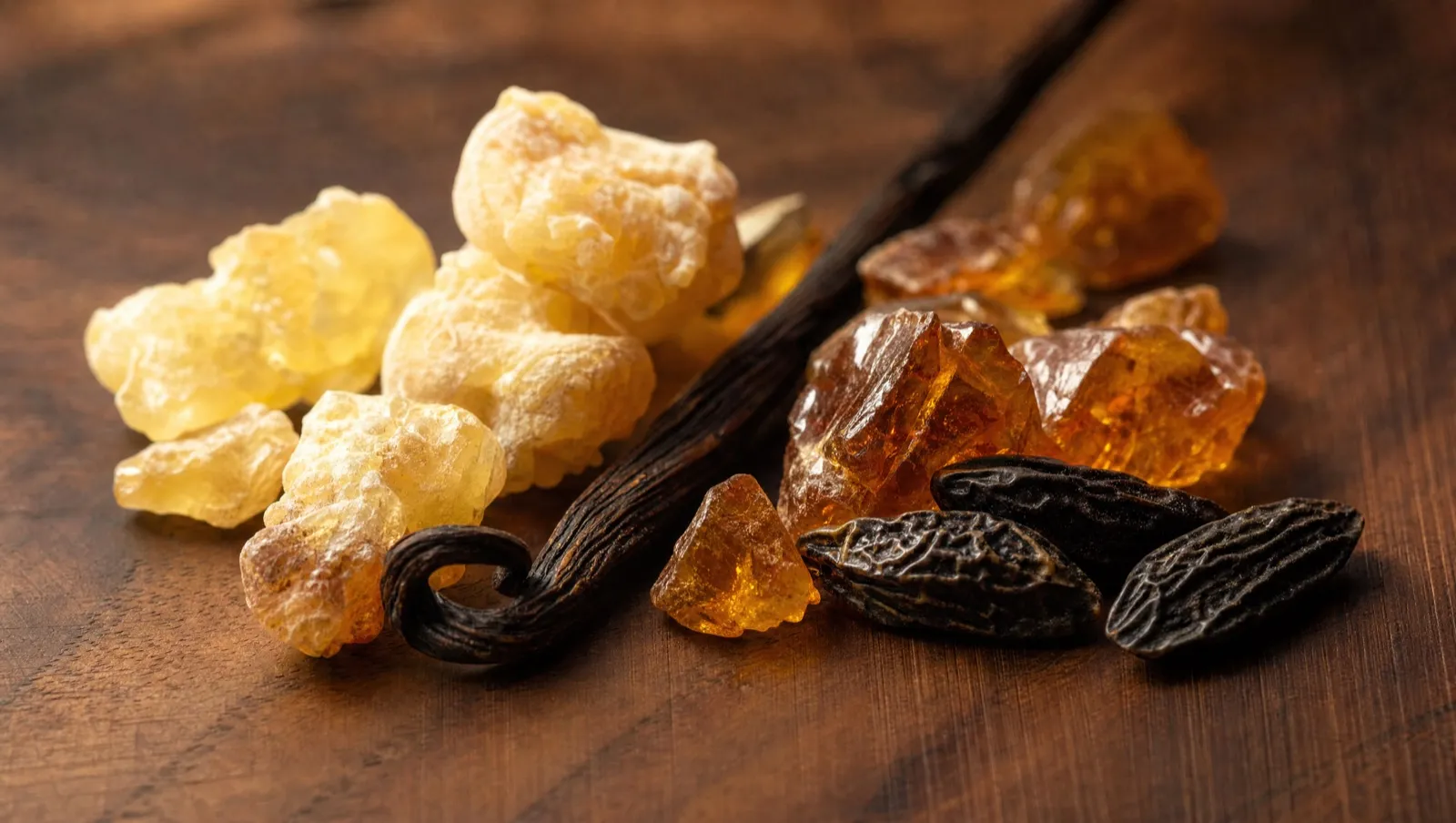
In perfumery, amber has nothing to do with the fossil resin used in jewelry.[1][4] The word began as a short form of ambergris.[1]
What an amber note is made of
Mandy Aftel writes in Essence and Alchemy that an amber note is usually created from labdanum combined with styrax, vanilla, civet or benzoin.[4] She calls ambers a popular base note in the oriental family and powerful fixatives.[5]
Labdanum is an oily resin from Cistus shrubs, the rock rose, native to the Mediterranean and the Middle East.[6] Perfumers often call it “amber”, Susan Irvine writes, and its smell somewhat resembles ambergris.[6] Nigel Groom’s New Perfume Handbook agrees that perfumers often call the fragrance of labdanum amber.[2]
Fragrances of the World cites a 1931 formula by the perfumer Félix Cola for Ambre Synthétique No 3: nitro musks, vanillin, benzoin and tolu balsam, with smaller amounts of incense, vetiver, patchouli and isoeugenyl acetate.[8]
Amber and ambergris
Ambergris is a waxy substance that researchers now generally accept as a pathological gut secretion of sperm whales, arising from undigested squid beaks.[19] Its smell is described as soft musky, animalic, marine, sweet, earthy and woody.[20] It occurs in only about 1 in 100 sperm whales, and bans on commercial whaling have increasingly limited its sources.[21]
Groom defines amber as a fragrance found in ambergris itself and in other natural materials, such as labdanum.[2] Fragrances of the World adds that the industry often uses “amber” as shorthand for ambergris and for a group of “woody-amber” ingredients.[12] It recommends that the industry refine this language to avoid confusing consumers.[13]
Ambroxan, a substitute for ambergris
Ambrein, one of the main constituents of ambergris, is odorless.[21][22] As it degrades, it yields (−)-ambroxide, the prototype of all ambergris odorants.[22]
(−)-Ambroxide is the most appreciated substitute for ambergris, with yearly use estimated at more than 100 tonnes.[23] Firmenich and Kao sell it as Ambroxan, among other names, and Givaudan makes it as Ambrofix.[23]
A 2020 review in Molecules reports that synthetic ambroxides have replaced ambergris in perfume manufacture, because the sperm whale is endangered.[25] A route to (−)-ambroxide from sclareol was first proposed in 1950.[24] Sclareol comes from clary sage and is used in the industrial production of ambrafuran, a compound also called Ambrox.[26][27]
From “oriental” to “amber”
In 1997, Groom noted that amber was sometimes used for the family more usually called oriental.[3] Karen Gilbert describes oriental fragrances as recalling resins, balsams and spices, and says they can be ambery, with notes of labdanum and vanilla.[7]
In a June media release titled “It’s Time to Change”, Michael Edwards announced that Fragrances of the World is replacing “Oriental” with “Amber” in all English-language classifications.[9] The renamed families are Floral Amber, Soft Amber, Amber and Woody Amber.[9] The trade magazine ParfumPlus reported that the update raised a few eyebrows in the fragrance industry.[14]
The Fragrances of the World article says the term Oriental was never intended to be offensive in perfumery, “but perceptions change”.[10] It defines the Amber family as blends of golden resins, opulent flowers and sweet vanilla.[11]
CPL Aromas replaced “oriental” with “amber” across its Olfactive Mapping, ParfumPlus reported.[15] Cosmetics Business wrote that fragrance houses were increasingly switching from “oriental” to “amber” in a bid for inclusivity.[18]
Not everyone agreed. Antoine de Riedmatten of Eurofragrance told ParfumPlus that, to his knowledge, most fragrance houses do not use the Edwards wheel.[16] He called the change “a weird move” and said amber is also used in several other olfactive families.[16] María Angeles Santiago, a senior perfumer at Iberchem, agreed to stop using “oriental”, but said “ambery” sounds wrong for a fragrance with notes of leather and smoke.[28][17]
Questions
Is amber the same as ambergris?
Not quite. The word amber began as a short form of ambergris, a secretion of sperm whales. In perfumery it names a scent found in ambergris and in other materials such as labdanum, whose fragrance perfumers often call amber.
Is amber perfume made from fossil amber?
No. In perfumery, amber has nothing to do with the fossilized resin used in jewelry. An amber note is usually made from labdanum combined with styrax, vanilla, civet or benzoin.
What is Ambroxan?
A trade name for (−)-ambroxide, the prototype of all ambergris odorants. It is the most appreciated substitute for ambergris, with yearly use estimated at more than 100 tonnes. Synthetic ambroxides have replaced ambergris in perfume manufacture.
Sources
- The New Perfume Handbook, Blackie Academic & Professional, 1997.
- The New Perfume Handbook, Blackie Academic & Professional, 1997.
- The New Perfume Handbook, Blackie Academic & Professional, 1997.
- Essence and Alchemy: A Book of Perfume, North Point Press, 2001.
- Essence and Alchemy: A Book of Perfume, North Point Press, 2001.
- Perfume: The Creation and Allure of Classic Fragrances, Crescent Books, 1995.
- Perfume: The Art and Craft of Fragrance, CICO Books, 2013.
- From Oriental, to Amber: Why it was time to rename the Oriental fragrance families, Retail Beauty (Fragrances of the World), 2021.
- From Oriental, to Amber: Why it was time to rename the Oriental fragrance families, Retail Beauty (Fragrances of the World), 2021.
- From Oriental, to Amber: Why it was time to rename the Oriental fragrance families, Retail Beauty (Fragrances of the World), 2021.
- From Oriental, to Amber: Why it was time to rename the Oriental fragrance families, Retail Beauty (Fragrances of the World), 2021.
- From Oriental, to Amber: Why it was time to rename the Oriental fragrance families, Retail Beauty (Fragrances of the World), 2021.
- From Oriental, to Amber: Why it was time to rename the Oriental fragrance families, Retail Beauty (Fragrances of the World), 2021.
- Goodbye Oriental... Hello Amber!, ParfumPlus Magazine, 2021.
- Industry Responds to “Goodbye Oriental, Hello Amber”, ParfumPlus Magazine, 2021.
- Industry Responds to “Goodbye Oriental, Hello Amber”, ParfumPlus Magazine, 2021.
- Industry Responds to “Goodbye Oriental, Hello Amber”, ParfumPlus Magazine, 2021.
- 'It's the perfume equivalent to taking the knee': Is it the end of oriental fragrances?, Cosmetics Business, 2021.
- Efforts toward Ambergris Biosynthesis, Chem & Bio Engineering, 2024. DOI: 10.1021/cbe.3c00083.
- Efforts toward Ambergris Biosynthesis, Chem & Bio Engineering, 2024. DOI: 10.1021/cbe.3c00083.
- Efforts toward Ambergris Biosynthesis, Chem & Bio Engineering, 2024. DOI: 10.1021/cbe.3c00083.
- Efforts toward Ambergris Biosynthesis, Chem & Bio Engineering, 2024. DOI: 10.1021/cbe.3c00083.
- Efforts toward Ambergris Biosynthesis, Chem & Bio Engineering, 2024. DOI: 10.1021/cbe.3c00083.
- Efforts toward Ambergris Biosynthesis, Chem & Bio Engineering, 2024. DOI: 10.1021/cbe.3c00083.
- Ambrafuran (AmbroxTM) Synthesis from Natural Plant Product Precursors, Molecules (MDPI), 2020. DOI: 10.3390/molecules25173851.
- Ambrafuran (AmbroxTM) Synthesis from Natural Plant Product Precursors, Molecules (MDPI), 2020. DOI: 10.3390/molecules25173851.
- Ambrafuran (AmbroxTM) Synthesis from Natural Plant Product Precursors, Molecules (MDPI), 2020. DOI: 10.3390/molecules25173851.
- Industry Responds to “Goodbye Oriental, Hello Amber”, ParfumPlus Magazine, 2021.