
Leather perfume: what makes a scent smell like leather
Leather notes in perfume come mainly from two raw materials: smoky rectified birch tar, which is natural, and inky isoquinolines, which are synthetic. Birch tar has the smell of Russian leather, which was prepared with it. One perfume book also lists isobutyl quinoline as a leather note and castoreum as a material of leather fragrances.
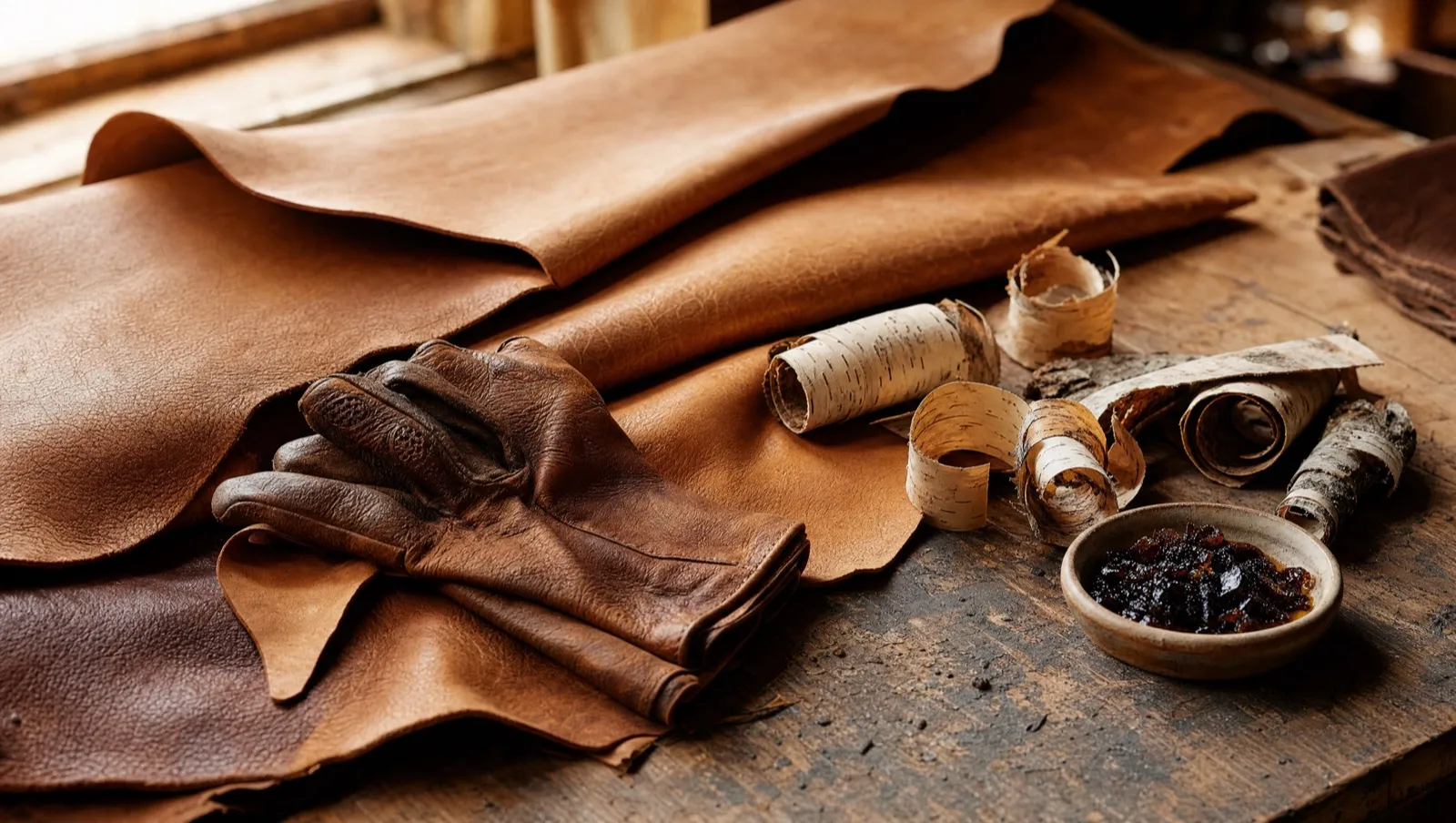
Leather notes in perfumery come chiefly from two raw materials: smoky rectified birch tar, which is natural, and inky isoquinolines, which are synthetic.[1] A perfume does not have to use both.[1]
Birch tar, the smell of Russian leather
A 1902 technical book on wood waste says birch tar and birch-tar oil have the odour of Russian leather, a leather prepared with birch tar.[7] Fabienne Pavia’s guide to perfume says essence of birch has a very pronounced smell of leather.[5]
Russia had a leather called yufte: cow, bull and possibly horse hide treated with birch oil and seal fat.[8] Researcher Valeria Tsygankova argues that yufte is the most likely candidate for the “russia calf” or “cuir de russie” used in the West in the 18th and 19th centuries.[8]
Isobutyl quinoline and Safraleine
Other perfumery books name a material called isobutyl quinoline.[9][11] Karen Gilbert, in her book on perfume, lists it, with labdanum or birch tar, as a leather note.[9] In their textbook, Robert Calkin and Stephan Jellinek write that Piguet’s Bandit was based on isobutyl quinoline and later inspired Cabochard.[11]
The fragrance house Givaudan describes its molecule Safraleine as having warm, powerful, leathery and tobacco facets.[12] Givaudan adds that its spice recalls natural saffron.[12]
Castoreum
Castoreum extract is made from the dried castor sac scent glands of the beaver.[10] It has been used extensively in perfumery, and as a food flavouring for at least 80 years.[10] Gilbert lists castoreum among the materials of chypre and leather fragrances, next to woods, mosses, labdanum, birch tar and isobutyl quinoline.[9]
Leather as a perfume family
The technical department of the Société Française des Parfumeurs (SFP), a French perfumers’ society, drew up a classification of perfume families.[2] The Comité Français du Parfum published it.[2]
In that classification, leather is a family of its own, described as something of a special case.[3] Its perfumes have dry notes that try to reproduce the smell of leather, such as smoke, burnt wood and tobacco.[3] Their top notes have floral overtones.[3]
The classification lists three groups within it: leather, flowery leather and leather tobacco.[4] Pavia’s book gives no illustrations for the family, because so few perfumes are of this type.[4]
Cuir de Russie
Ernest Beaux created Cuir de Russie for Parfums Chanel in 1924, according to a history published in Perfumer & Flavorist.[13] The same authors write that Beaux used birch tar oil “so skillfully” in it.[14]
Pavia gives a later date for the style: she writes that the leather group arrived in the 1930s, with Lanvin’s Scandal and Chanel’s Cuir de Russie as examples.[6] Her decade does not match the 1924 date given by Perfumer & Flavorist.[6][13]
Perfumed gloves in Grasse
Perfume writer Denyse Beaulieu describes Grasse, in the south of France, as the town where perfumery grew out of leather tanning.[15] Tanning products smelled rank, she writes, so fine leathers were steeped in aromatic essences.[15]
Researchers Vincent Lambert and Paul Rasse report the same story: Grasse craftsmen are said to have masked the strong smell of leather with ointments of local aromatic plants.[16] They add that historians now qualify this account of the origins of Grasse perfumery.[16] In their reading, Grasse perfumery descends less from glovers than from pharmacists, who used the same methods: maceration, infusion and distillation.[17]
By the middle of the 18th century, Grasse perfumers excelled at fine perfumed gloves, a luxury prized by Europe’s aristocracies.[18] In the second half of that century, a crisis in the leather industry led some glover-perfumers to become perfumers only.[18]
Questions
What does a leather perfume smell like?
In the classification of the Société Française des Parfumeurs, leather perfumes have dry notes that try to reproduce the smell of leather, such as smoke, burnt wood and tobacco, with floral top notes.
What is birch tar in perfume?
Birch tar, and the oil made by redistilling it, has the smell of Russian leather, which was prepared with birch tar. Rectified birch tar is one of the two main sources of leather notes in perfumery.
What is castoreum?
Castoreum extract comes from the dried castor sac scent glands of the beaver and has been used extensively in perfumery. It is used in chypre and leather fragrances.
Sources
- Perfumes: The A–Z Guide, Profile Books, 2009.
- The World of Perfume, Knickerbocker Press, 1996.
- The World of Perfume, Knickerbocker Press, 1996.
- The World of Perfume, Knickerbocker Press, 1996.
- The World of Perfume, Knickerbocker Press, 1996.
- The World of Perfume, Knickerbocker Press, 1996.
- The Utilisation of Wood-Waste, Scott, Greenwood & Co., 1902.
- Russian Yufte as ‘Russia Leather’ in Eighteenth- and Nineteenth-Century Western Bookbinding, Ligatus Research Centre, University of the Arts London.
- Perfume: The Art and Craft of Fragrance, CICO Books, 2013.
- Safety assessment of castoreum extract as a food ingredient, International Journal of Toxicology, 2007. DOI: 10.1080/10915810601120145.
- Perfumery: Practice and Principles, John Wiley & Sons, 1994.
- Safraleine™, Givaudan.
- From Rallet Nº1 to Chanel Nº5 versus Mademoiselle Chanel Nº1, Perfumer & Flavorist, 2007.
- From Rallet Nº1 to Chanel Nº5 versus Mademoiselle Chanel Nº1, Perfumer & Flavorist, 2007.
- The Perfume Lover: A Personal Story of Scent, Collins, 2012.
- Paradoxes et bilan critique des processus de patrimonialisation dans les industries aromatiques de Grasse, Recherches en communication, 2018. DOI: 10.14428/rec.v45i45.47763.
- Paradoxes et bilan critique des processus de patrimonialisation dans les industries aromatiques de Grasse, Recherches en communication, 2018. DOI: 10.14428/rec.v45i45.47763.
- Paradoxes et bilan critique des processus de patrimonialisation dans les industries aromatiques de Grasse, Recherches en communication, 2018. DOI: 10.14428/rec.v45i45.47763.