Vanilla in perfume: from orchid pod to vanillin
Vanilla's main aromatic compound, vanillin, gives a perfume a base note. Vanillin makes up about 80% of the aromatic compounds in the Vanilla planifolia orchid, among more than 250 compounds. Perfumers count vanillin among the undisputed base notes and value it as a fixative. Chemists first synthesized vanillin in 1874, and most vanillin today is made chemically.
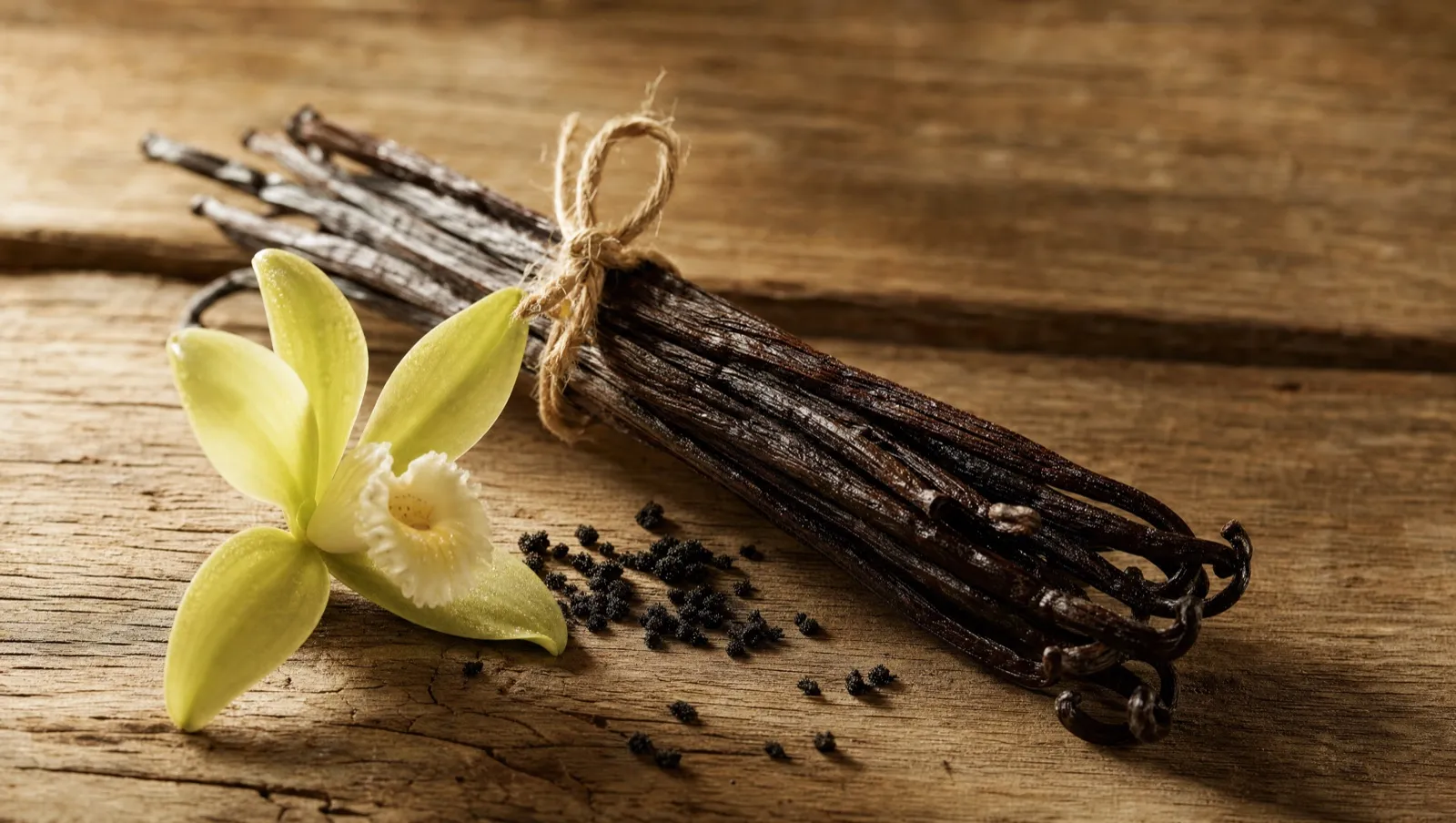
Vanillin makes up about 80% of the aromatic compounds in Vanilla planifolia, among more than 250 compounds in natural vanilla.[2][6] Perfumers count vanillin among the undisputed base notes.[14]
From orchid pod to vanilla bean
Natural vanilla is a spice made from the fruit of orchid vines.[1] The vine is native to Mexico and tropical America, and its pods are picked and fermented.[9]
The Mayans, Olmecs, Aztecs and Totonacs flavored drinks with vanilla, held it sacred and used it to perfume their temples.[4] It reached Europe in the 16th century, after the Spanish conquest of the Aztecs.[3] It was not grown outside its native range until 1832, when Edmond Albius, on Reunion Island, found a way to pollinate the flowers by hand.[3]
In the vanilla bean, the flavor waits in a precursor called glucovanillin, which goes through enzymatic hydrolysis during curing.[7] In the best pods, vanillin shows on the surface as small white needle crystals, called givre in French.[5]
Vanillin, the main aromatic compound in vanilla
Natural vanilla owes its flavor to a mixture of more than 250 compounds.[6] Vanillin is the largest share: 80% of the aromatics in Vanilla planifolia and 50% in Vanilla × tahitensis.[2]
In 1874, the chemists Wilhelm Haarmann and Ferdinand Tiemann synthesized vanillin for the first time.[10] They extracted it in several stages from the sap of conifers.[11] Today, 95% of vanillin is made chemically from lignin and guaiacol.[8]
Vanillin alone is not the whole of vanilla: Nancy Booth notes that it lacks the full-bodied quality of vanilla.[16]
How vanilla entered perfumery
Jicky, created by Guerlain in 1889, marked the advent of vanillin in perfume, according to a history from the Musée international de la parfumerie.[12]
Patricia Rain, author of a cultural history of vanilla, dates its rise as a dominant aroma in perfumery to 1925, when Guerlain launched Shalimar.[13] In her account, Shalimar was the first perfume with ethyl vanillin, an artificial molecule that smells of vanilla.[13] Ethyl vanillin is about 4 times as strong as vanillin.[15]
Vanillin as a base note
In their perfumery textbook, Robert Calkin and J. Stephan Jellinek list vanillin among the undisputed base notes, next to oakmoss, patchouli, most woody materials and the musks.[14] To see where base notes sit in a perfume, read top, heart and base notes.
Vanillin is also a valued fixative in perfumery.[16]
Gourmand perfumes
In the 1990s, perfume companies took the vanilla in oriental fragrances toward food, adding dessert-like confectionery notes.[17] That created the gourmand sub-category.[17] Karen Gilbert gives Thierry Mugler’s Angel as an example, with notes of chocolate, caramel and cotton candy.[18]
If you smell pure vanilla absolute, it will not match the vanilla notes in food or bath products.[19] Those notes are usually made with ethyl vanillin and vanillin.[19] The absolute costs more, and it smells less sweet and more woody.[19]
Questions
Is vanillin a top note or a base note?
A base note. Perfumers list vanillin among the undisputed base notes, with oakmoss, patchouli, most woody materials and the musks. Vanillin is also valued as a fixative in perfumery.
Is vanillin the same as vanilla?
No. Natural vanilla owes its flavor to more than 250 compounds, and vanillin is the largest share: 80% of the aromatics in Vanilla planifolia. Most vanillin today, 95%, is made chemically from lignin and guaiacol.
What is a gourmand perfume?
A sub-category that grew from oriental fragrances in the 1990s, when perfume companies added dessert-like confectionery notes to their vanilla. Thierry Mugler's Angel, with chocolate, caramel and cotton candy, is one example.
Sources
- Vanilla beyond Vanilla planifolia and Vanilla × tahitensis: Taxonomy and Historical Notes, Reproductive Biology, and Metabolites, Plants (MDPI), 2022. DOI: 10.3390/plants11233311.
- Vanilla beyond Vanilla planifolia and Vanilla × tahitensis: Taxonomy and Historical Notes, Reproductive Biology, and Metabolites, Plants (MDPI), 2022. DOI: 10.3390/plants11233311.
- Vanilla beyond Vanilla planifolia and Vanilla × tahitensis: Taxonomy and Historical Notes, Reproductive Biology, and Metabolites, Plants (MDPI), 2022. DOI: 10.3390/plants11233311.
- Vanilla beyond Vanilla planifolia and Vanilla × tahitensis: Taxonomy and Historical Notes, Reproductive Biology, and Metabolites, Plants (MDPI), 2022. DOI: 10.3390/plants11233311.
- Vanilla beyond Vanilla planifolia and Vanilla × tahitensis: Taxonomy and Historical Notes, Reproductive Biology, and Metabolites, Plants (MDPI), 2022. DOI: 10.3390/plants11233311.
- Vanilla beyond Vanilla planifolia and Vanilla × tahitensis: Taxonomy and Historical Notes, Reproductive Biology, and Metabolites, Plants (MDPI), 2022. DOI: 10.3390/plants11233311.
- A comprehensive review of eclectic approaches to the biological synthesis of vanillin and their application towards the food sector, Food Science and Biotechnology, 2024. DOI: 10.1007/s10068-023-01484-x.
- A comprehensive review of eclectic approaches to the biological synthesis of vanillin and their application towards the food sector, Food Science and Biotechnology, 2024. DOI: 10.1007/s10068-023-01484-x.
- Perfume: The Ultimate Guide to the World's Finest Fragrances, Running Press, 1999.
- The cornerstone of a global enterprise, Symrise.
- The cornerstone of a global enterprise, Symrise.
- Une histoire mondiale du parfum : des origines à nos jours, Somogy / Musée international de la parfumerie, 2007.
- Vanilla: The Cultural History of the World's Most Popular Flavor and Fragrance, J.P. Tarcher/Penguin, 2004.
- Perfumery: Practice and Principles, John Wiley & Sons, 1994.
- Perfumery: Practice and Principles, John Wiley & Sons, 1994.
- Perfumes, Splashes and Colognes, Storey Communications, 1997.
- Perfume: The Art and Craft of Fragrance, CICO Books, 2013.
- Perfume: The Art and Craft of Fragrance, CICO Books, 2013.
- Perfume: The Art and Craft of Fragrance, CICO Books, 2013.