
Oud perfume: what agarwood is and why it is prized
Oud, also called agarwood, is the fragrant resinous heartwood of Aquilaria trees, formed when a tree is wounded and infected by fungi. It is rare and costly: only about 10% of trees form it, overharvesting has depleted wild stocks, and the oil sells for thousands of US dollars per kilogram.
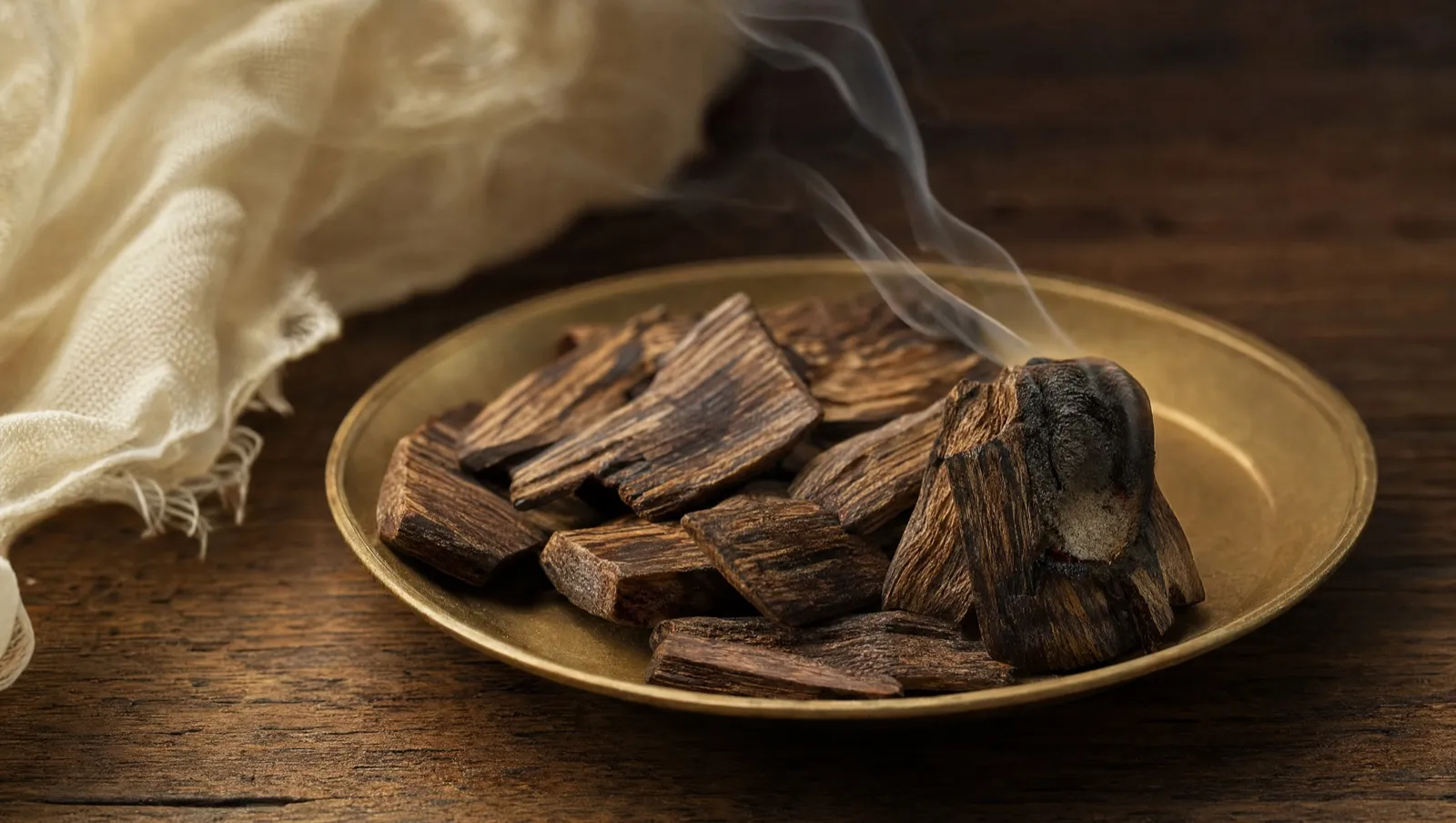
Oud is one of several names for agarwood, the fragrant heartwood of Aquilaria trees.[2] It is traded worldwide for incense, perfume and medicine.[1]
How agarwood forms
Aquilaria trees belong to the Thymelaeaceae family.[2] Agarwood forms when a tree is wounded and infected by fungi, and the tree produces resin as a defense.[1] Only around 10% of Aquilaria trees form agarwood, and the process can take up to 25 years.[8]
Agarwood is harvested by felling trees and splitting them open.[16] Outward signs are not always obvious, so trees are often cut down indiscriminately in the search.[16]
What oud smells like
In 2012, Christian Provenzano, director of perfumery at CPL Aromas, said in Perfumer & Flavorist that oud on its own is woody, leathery, fatty and animalic.[22] He said it can recall sheep skin, and becomes more pleasant with rose oil, saffron and sandalwood oil, if not overdosed.[22]
Why oud is so expensive
A 2022 review in Molecules says overharvesting amid rising demand has made agarwood a rare and valuable commodity.[3] A 2000 report by TRAFFIC found that demand far exceeded supply, which is limited because agarwood occurs in only a small share of trees.[17]
TRAFFIC lists what sets the grade and value: country of origin, fragrance strength and longevity, wood density, purity, resin content, colour and size.[18]
Prices vary by year and grade: TRAFFIC put agarwood oil at 5,000 to 10,000 US dollars per kilogram, and more for exceptional oil.[17] The Molecules review cites about 10,000 US dollars per kilogram for first-grade wood and 30 for the lowest grade.[5] It also cites oil sold at 30,000 to 40,000 US dollars per kilogram.[6] Provenzano put pure oud oil at up to £20,000 per kilogram in 2012.[23] Ammar Nabeel Adam Ali of Swiss Arabian Perfumes told Gulf News in 2026 that pure oud is priced higher than gold per gram.[30]
Protection under CITES
The Convention on International Trade in Endangered Species of Wild Fauna and Flora (CITES) held its 13th conference, CoP13, in October 2004.[11] One agarwood species, Aquilaria malaccensis, was already listed in its Appendix II in 1995.[10] CoP13 listed all the other agarwood-producing species in the genera Aquilaria and Gyrinops.[10]
Appendix II covers species that may become threatened if trade is not regulated.[12] Trade in wild specimens is allowed, subject to permit.[12]
Reviews disagree on how many Aquilaria species exist.[7][9] A 2022 review counts 21, with 9 that produce agarwood.[7] A 2025 review counts 20 and says 5 of them are classified as critically endangered.[9]
Oud in the Middle East and Asia
TRAFFIC notes agarwood’s medicinal use in the Sahih Muslim, from about the 8th century, and in the Ayurvedic text Susruta Samhita.[13] Its use as a perfume is recorded in the Old Testament.[13]
In the Middle East, agarwood smoke and oil are customarily used as perfume.[15] In India, grades of agarwood are distilled separately, then blended into an attar.[15] Buddhists, Hindus and Muslims use agarwood incense in religious ceremonies.[14] In Japan, a revival of the Koh doh incense ceremony has renewed interest in agarwood.[14]
Demand for the oil is high in Japan, China, the United Arab Emirates and Saudi Arabia.[4] In the Middle East, the oil symbolizes wealth, culture and hospitality.[4]
Ali told Gulf News that Arabian perfumery focuses on burning incense on clothes and applying oud oil.[29] He added that Arabian fragrances tend to use oud, amber, musk and saffron as a base.[31]
Oud in Western perfumery
In 1999, perfumer Arcadi Boix Camps wrote that natural agarwood was scarce but used in good quantities in Middle Eastern perfumery.[25] He described work on the olfactive reconstitution of agarwood oils, with good success from what he called bioagarwood oils.[32]
Khaleej Times calls Yves Saint Laurent’s M7, launched in 2002, the first Western interpretation of oud.[26] It lists later examples: Tom Ford’s Oud Wood (2007), Dior’s Oud Ispahan (2012) and Gucci’s Intense Oud (2016).[27] In 2012, Provenzano said oud oil could be seen in new launches from Dior, Armani, Tom Ford, YSL and others.[24]
The National wrote in 2014 that the West gets a largely ersatz version of oud.[28]
TRAFFIC reported in 2000 that the cheapest agarwood perfumes are either synthetic or a blend of oils.[19] The main compounds in agarwood oil are sesquiterpenes, which the report calls very difficult and expensive to synthesize.[20] Synthetic agarwood oil then sold for less than 100 US dollars per kilogram.[21]
Questions
What does oud smell like?
Christian Provenzano, director of perfumery at CPL Aromas, said in 2012 that oud on its own has strong woody, leathery, fatty and animalic notes. He added that it becomes more pleasant with rose oil, saffron and sandalwood oil, if it is not overdosed.
Why is oud so expensive?
Only about 10% of Aquilaria trees form agarwood, over as long as 25 years, and overharvesting has made it rare. TRAFFIC put agarwood oil at 5,000 to 10,000 US dollars per kilogram in 2000; a 2022 review cites 30,000 to 40,000.
Is the oud in perfume real?
Not always. TRAFFIC reported in 2000 that the cheapest agarwood perfumes are either synthetic or a blend of oils, and that synthetic agarwood oil sold for less than 100 US dollars per kilogram.
Sources
- Agarwood—The Fragrant Molecules of a Wounded Tree, Molecules (MDPI), 2022. DOI: 10.3390/molecules27113386.
- Agarwood—The Fragrant Molecules of a Wounded Tree, Molecules (MDPI), 2022. DOI: 10.3390/molecules27113386.
- Agarwood—The Fragrant Molecules of a Wounded Tree, Molecules (MDPI), 2022. DOI: 10.3390/molecules27113386.
- Agarwood—The Fragrant Molecules of a Wounded Tree, Molecules (MDPI), 2022. DOI: 10.3390/molecules27113386.
- Agarwood—The Fragrant Molecules of a Wounded Tree, Molecules (MDPI), 2022. DOI: 10.3390/molecules27113386.
- Agarwood—The Fragrant Molecules of a Wounded Tree, Molecules (MDPI), 2022. DOI: 10.3390/molecules27113386.
- Agarwood—The Fragrant Molecules of a Wounded Tree, Molecules (MDPI), 2022. DOI: 10.3390/molecules27113386.
- Towards sustainable agarwood production: integrating microbial interactions, anatomical changes, and metabolite biosynthesis, Journal of Industrial Microbiology & Biotechnology, 2025. DOI: 10.1093/jimb/kuaf025.
- Towards sustainable agarwood production: integrating microbial interactions, anatomical changes, and metabolite biosynthesis, Journal of Industrial Microbiology & Biotechnology, 2025. DOI: 10.1093/jimb/kuaf025.
- CITES, trade and sustainable forest management, FAO (Unasylva, vol. 55, no. 219), 2004.
- CITES, trade and sustainable forest management, FAO (Unasylva, vol. 55, no. 219), 2004.
- CITES, trade and sustainable forest management, FAO (Unasylva, vol. 55, no. 219), 2004.
- Heart of the Matter: Agarwood Use and Trade and CITES Implementation for Aquilaria malaccensis, TRAFFIC International, 2000.
- Heart of the Matter: Agarwood Use and Trade and CITES Implementation for Aquilaria malaccensis, TRAFFIC International, 2000.
- Heart of the Matter: Agarwood Use and Trade and CITES Implementation for Aquilaria malaccensis, TRAFFIC International, 2000.
- Heart of the Matter: Agarwood Use and Trade and CITES Implementation for Aquilaria malaccensis, TRAFFIC International, 2000.
- Heart of the Matter: Agarwood Use and Trade and CITES Implementation for Aquilaria malaccensis, TRAFFIC International, 2000.
- Heart of the Matter: Agarwood Use and Trade and CITES Implementation for Aquilaria malaccensis, TRAFFIC International, 2000.
- Heart of the Matter: Agarwood Use and Trade and CITES Implementation for Aquilaria malaccensis, TRAFFIC International, 2000.
- Heart of the Matter: Agarwood Use and Trade and CITES Implementation for Aquilaria malaccensis, TRAFFIC International, 2000.
- Heart of the Matter: Agarwood Use and Trade and CITES Implementation for Aquilaria malaccensis, TRAFFIC International, 2000.
- Establishing and Operating a Fragrance House in the Middle East, Perfumer & Flavorist, 2012.
- Establishing and Operating a Fragrance House in the Middle East, Perfumer & Flavorist, 2012.
- Establishing and Operating a Fragrance House in the Middle East, Perfumer & Flavorist, 2012.
- Perfumery: Techniques in Evolution IV, Perfumer & Flavorist, 1999.
- Why is the West obsessed with ancient Oud?, Khaleej Times, 2025.
- Why is the West obsessed with ancient Oud?, Khaleej Times, 2025.
- Oud: Scent & Sensibilites, The National, 2014.
- What really goes into UAE perfumes? Inside the ‘liquid gold’ world of oud and beyond, Gulf News, 2026.
- What really goes into UAE perfumes? Inside the ‘liquid gold’ world of oud and beyond, Gulf News, 2026.
- What really goes into UAE perfumes? Inside the ‘liquid gold’ world of oud and beyond, Gulf News, 2026.
- Perfumery: Techniques in Evolution IV, Perfumer & Flavorist, 1999.