History of perfume: from Mesopotamian tablets to synthetics
Perfume's history runs from Mesopotamian tablets naming the perfumer Tapputi-Belatekallim to fat-based Egyptian scents and kyphi, Greek and Roman recipes, and al-Kindī's book of 107 perfume recipes in the 9th century. Europe added Hungary water and, in 1709, eau de cologne. In the early 1880s, synthetic coumarin became a key ingredient of a Houbigant perfume.
Pliny the Elder wrote that who first made unguents is not recorded.[13]
Mesopotamia: a perfumer on a tablet
Writing in the history-of-chemistry annual Chymia, Martin Levey called texts on making perfumed oils, salves and waters in Mesopotamia the most important group of pre-classical source texts.[1] One tablet, in his translation, gives a preparation of flowers, oil and calamus for the king, after the recipe of Tapputi-Belatekallim, “the perfumeress”.[2]
In a history of women in science, Margaret Alic writes that cuneiform tablets from the second millennium BC name her as one of 2 early women chemists.[4] Belatekallim, Alic adds, indicates a female overseer of the palace.[5] Levey notes that in Babylonian chemistry of that millennium, perfume water was made by extracting balsam with water 40 times.[3]
Egypt: scented fats and kyphi
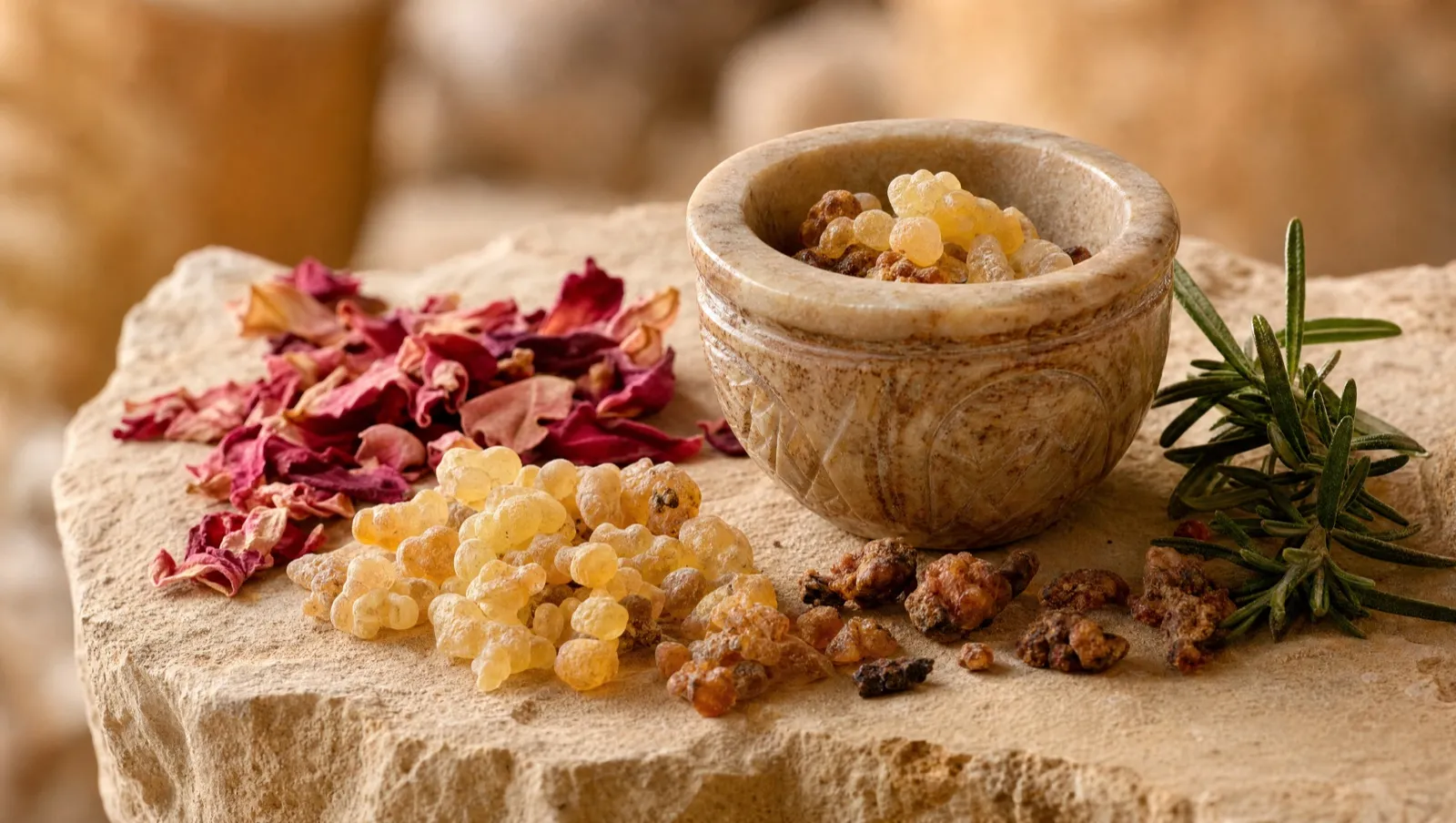
In the UCLA Encyclopedia of Egyptology, Lise Manniche writes that perfume in Egypt was fat-based.[6] Texts most often name frankincense, myrrh, cinnamon, cassia and cardamom, and scent had an important role in temple and funeral rites.[6] Distillation seems to have been known elsewhere around 2000 BCE, she adds, but there is no proof it was used in Pharaonic Egypt.[7]
The most famous Egyptian scent was kyphi, known from temple walls at Edfu and Philae, from the Ebers papyrus and from the Pyramid Texts.[8] Its name renders the Egyptian kapet, a substance to be smoked.[8] Plutarch listed 16 ingredients, among them honey, wine, raisins, resin, myrrh, juniper, cardamom and calamus.[11]
Tutankhamun’s tomb held some 350 liters of oils and fats, some in carved calcite containers.[9]
Greece and Rome
Classical authors gave many perfume recipes that refer to Egyptian practice, and those scents were aimed at Greek or Roman buyers, Manniche notes.[10] In Concerning Odours, Theophrastus explained that perfumes are made from flowers, leaves, twigs, roots, wood, fruit and gum, usually from several parts mixed.[12]
Pliny ascribed the first use of unguents to the Persians.[14] He also recorded how fashions changed: the most prized perfumes came first from the island of Delos and later from Mendes.[15]
Al-Kindī and distillation
Al-Kindī, a philosopher who worked in the 9th century, wrote a book on perfume with 107 recipes in 3 groups, sorted by method.[18][16] The third group covers the distillation of aromatic waters, Takatomo Inoue writes.[17] The Arabic perfume page covers al-Kindī and rose water in more detail.
Europe: Hungary water, gloves and cologne
Hungary water is spirit of wine distilled on rosemary, wrote Johann Beckmann in his history of inventions.[19] Many books, he noted, said a hermit or an angel gave the recipe to a queen of Hungary.[20] The earliest printing Beckmann knew of was in a small book by John Prevot.[21] He thought it more likely that later sellers of rosemary water chose the name to give their product credit.[22]
In Grasse, perfumers excelled at fine perfumed gloves around the middle of the 18th century, according to researchers Vincent Lambert and Paul Rasse.[23] They also report, drawing on earlier historical work, that Grasse perfumery descends less from glovers than from pharmacists who used the same techniques.[24] The France page follows Grasse to the present day.
A Baedeker guide to Cologne says the first eau de cologne was invented in 1709 by Giovanni Maria Farina, an Italian immigrant.[25]
Synthetic materials and modern perfume
In the early 1880s, Parquet conceived a perfume for a Houbigant toilet soap, with synthetic coumarin as a key ingredient, writes David G. Williams in The Chemistry of Essential Oils.[26] The soap was named Fougère Royale, and Williams dates its launch to 1882.[26][27] Williams calls it the first perfume based on a synthetic chemical to be so recognized.[28]
A 2007 history from the Musée international de la parfumerie gives 1884 instead.[29] It says Fougère Royale named the fougère family and was the first known use of coumarin.[29] Guerlain’s Jicky, from 1889, marked the arrival of vanillin and was considered the first modern perfume, the book adds.[29]
In 1912, perfumer Robert Bienaimé used the aldehyde C-12 MNA for the first time, in Houbigant’s Quelques Fleurs, according to Perfumer & Flavorist.[30] The same article says Chanel No. 5 appears to have started as 100 bottles that Chanel gave her best customers as a Christmas gift in 1921.[31] Chanel launched it officially in 1922.[32]
Questions
Who invented perfume?
Pliny the Elder wrote that who first made unguents is not recorded. Cuneiform tablets from the second millennium BC name a perfumer, Tapputi-Belatekallim, called "the perfumeress" in Martin Levey's translation.
Was Hungary water really made for a queen of Hungary?
Johann Beckmann doubted it. He noted that many books said a hermit or an angel gave the recipe to a queen of Hungary, and he thought later sellers of rosemary water chose the name to give their product credit.
What was the first modern perfume?
A 2007 history from the Musée international de la parfumerie says Guerlain's Jicky, from 1889, was considered the first modern perfume. David G. Williams calls Houbigant's Fougère Royale the first perfume based on a synthetic chemical to be so recognized.
Sources
- A Group of Akkadian Texts on Perfumery (Martin Levey), Chymia, vol. 6 (University of Pennsylvania Press).
- A Group of Akkadian Texts on Perfumery (Martin Levey), Chymia, vol. 6 (University of Pennsylvania Press).
- Early Muslim Chemistry: Its Debt to Ancient Babylonia (Martin Levey), Chymia, vol. 6 (University of Pennsylvania Press).
- Hypatia's Heritage: A History of Women in Science from Antiquity through the Nineteenth Century, Beacon Press, 1986.
- Hypatia's Heritage: A History of Women in Science from Antiquity through the Nineteenth Century, Beacon Press, 1986.
- Perfume (UCLA Encyclopedia of Egyptology), UCLA Encyclopedia of Egyptology, 2009.
- Perfume (UCLA Encyclopedia of Egyptology), UCLA Encyclopedia of Egyptology, 2009.
- Perfume (UCLA Encyclopedia of Egyptology), UCLA Encyclopedia of Egyptology, 2009.
- Perfume (UCLA Encyclopedia of Egyptology), UCLA Encyclopedia of Egyptology, 2009.
- Perfume (UCLA Encyclopedia of Egyptology), UCLA Encyclopedia of Egyptology, 2009.
- Isis and Osiris (Moralia), Plutarch, tr. F. C. Babbitt, ch. 80, LacusCurtius (Loeb Classical Library text), 1936.
- Concerning Odours, in Enquiry into Plants, vol. 2 (Theophrastus, tr. Arthur Hort), Loeb Classical Library (Heinemann), 1916.
- The Natural History, Pliny the Elder, book 13, chapter 1 (tr. John Bostock and H. T. Riley), Perseus Digital Library (Tufts University), 1855.
- The Natural History, Pliny the Elder, book 13, chapter 1 (tr. John Bostock and H. T. Riley), Perseus Digital Library (Tufts University), 1855.
- The Natural History, Pliny the Elder, book 13, chapter 2 (tr. John Bostock and H. T. Riley), Perseus Digital Library (Tufts University), 1855.
- Al-Kindī's Attack on Alchemy and His Perfume Making, ORIENT (Society for Near Eastern Studies in Japan), 2017. DOI: 10.5356/orient.52.72.
- Al-Kindī's Attack on Alchemy and His Perfume Making, ORIENT (Society for Near Eastern Studies in Japan), 2017. DOI: 10.5356/orient.52.72.
- Al-Kindī's Attack on Alchemy and His Perfume Making, ORIENT (Society for Near Eastern Studies in Japan), 2017. DOI: 10.5356/orient.52.72.
- A History of Inventions, Discoveries, and Origins, vol. 1 (Johann Beckmann), "Hungary Water", Henry G. Bohn (London), 1846.
- A History of Inventions, Discoveries, and Origins, vol. 1 (Johann Beckmann), "Hungary Water", Henry G. Bohn (London), 1846.
- A History of Inventions, Discoveries, and Origins, vol. 1 (Johann Beckmann), "Hungary Water", Henry G. Bohn (London), 1846.
- A History of Inventions, Discoveries, and Origins, vol. 1 (Johann Beckmann), "Hungary Water", Henry G. Bohn (London), 1846.
- Paradoxes et bilan critique des processus de patrimonialisation dans les industries aromatiques de Grasse, Recherches en communication (UCLouvain), 2018. DOI: 10.14428/rec.v45i45.47763.
- Paradoxes et bilan critique des processus de patrimonialisation dans les industries aromatiques de Grasse, Recherches en communication (UCLouvain), 2018. DOI: 10.14428/rec.v45i45.47763.
- Cologne (Baedeker guide), Baedeker (Ostfildern), 2012.
- The Chemistry of Essential Oils: An Introduction for Aromatherapists, Beauticians, Retailers & Students, Micelle Press, 1996.
- The Chemistry of Essential Oils: An Introduction for Aromatherapists, Beauticians, Retailers & Students, Micelle Press, 1996.
- The Chemistry of Essential Oils: An Introduction for Aromatherapists, Beauticians, Retailers & Students, Micelle Press, 1996.
- Perfume, a Global History: From the Origins to Today, Somogy / Musée international de la parfumerie, 2007.
- From Rallet Nº1 to Chanel Nº5 versus Mademoiselle Chanel Nº1, Perfumer & Flavorist, 2007.
- From Rallet Nº1 to Chanel Nº5 versus Mademoiselle Chanel Nº1, Perfumer & Flavorist, 2007.
- From Rallet Nº1 to Chanel Nº5 versus Mademoiselle Chanel Nº1, Perfumer & Flavorist, 2007.