French perfume: from Grasse's fields to Guerlain and Chanel
UNESCO dates perfume skills in the Pays de Grasse to at least the 16th century; in 1950 Grasse controlled 95% of the world market for natural aromatic raw materials. UNESCO listed those skills in 2018. Guerlain's shop opened in 1828, Poiret's perfume company in 1911, and Chanel No. 5 was launched officially in 1922.
Grasse on the UNESCO list
In 2018, UNESCO inscribed the perfume skills of Pays de Grasse on its Representative List of the Intangible Cultural Heritage of Humanity.[1] France had added them to its own inventory of intangible cultural heritage in April 2014.[16]
The listing covers 3 skills: growing perfume plants, knowing and processing natural raw materials, and the art of perfume composition.[2] According to UNESCO, this knowledge passes on mostly informally, through a long training that still takes place mainly in perfumeries.[4] It adds that interest in formal teaching has grown in recent decades.[4]
How perfumery took root in Grasse
Sources date the start differently.[3][5] UNESCO says Pays de Grasse has grown and processed perfume plants since at least the 16th century, in a craft industry long dominated by leather tanning.[3] Researchers Vincent Lambert and Paul Rasse, quoting earlier work, write that it is more accurate to place the start in the 17th century, when Grasse competed with Montpellier.[5]
In 1685, the Edict of Fontainebleau drove Huguenot doctors and herbalists out of Protestant Montpellier, and Grasse grew.[6] To compete with Dutch, Spanish and Italian trade, the economic policy of Louis XIV organised the luxury industry inside France’s borders.[7] Two centres grew from it: one near the seat of power at Versailles, the other at Grasse, close to Italy.[7]
The part played by Grasse’s glover-perfumers, and the debate about it, is on the leather perfume page.
Flowers, solvents and factories abroad
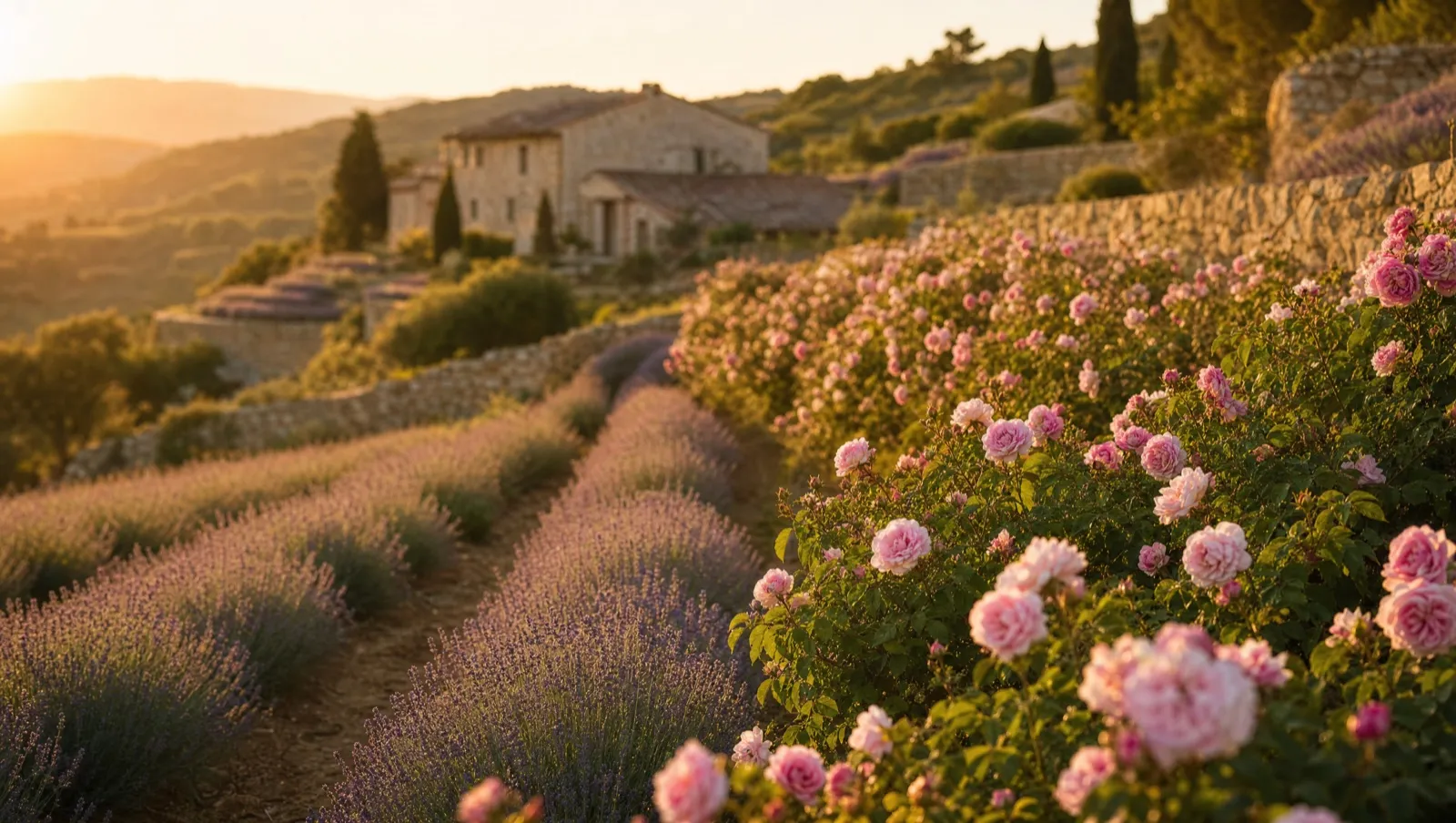
In the 19th century, Grasse craftsmen developed enfleurage, which for the first time captured the scent of the most fragile flowers, such as jasmine, rose and tuberose.[8] Demand rose fast, and within a few years the countryside around Grasse was covered with perfume plants.[9] The floral perfume page explains how these extraction methods work.
At the end of the 19th century, advances in chemistry gave people in Grasse the idea of extracting scent with volatile solvents, mainly benzene.[10] From 1906, Grasse industrialists built factories in Lebanon, Egypt, Réunion, the Italian Riviera, Georgia and the Maghreb.[11] The raw extracts, called concretes, came back to Grasse to be refined and blended into perfumes.[12]
Grasse became the world capital of perfumery, a hub between raw-material supply and perfume sales.[12] In 1950 it controlled 95% of the world market for natural aromatic raw materials.[12]
Grasse today
In their 2018 article, Lambert and Rasse count 70 aromatic establishments in Grasse, a town on the Côte d’Azur, with 3,300 direct jobs.[13][15] Together they produce more than 50% of France’s aromatic ingredients.[13] Since the early 21st century, some large companies, including Chanel, Dior and LVMH, have returned to Grasse.[14]
Perfume houses and couturiers
In 1828, Pierre-François Pascal Guerlain, a young doctor and chemist, opened a shop on the rue de Rivoli selling his own powders and perfumes.[17] One of them, Eau de Cologne Impériale, earned him Empress Eugénie’s royal warrant.[17] The eau de cologne style is older: the Farina fragrance museum says Johann Maria Farina invented the original in 1709.[24]
A 2007 history from the Musée International de la Parfumerie in Grasse describes 2 perfumes of the late 19th century.[18] Houbigant’s Fougère Royale, from 1884, gave its name to the fougère family and was the first known use of coumarin.[18] Guerlain’s Jicky, from 1889, also used coumarin and marked the arrival of vanillin.[18] The same book says Jicky was considered the first modern perfume.[18]
In 1911, the fashion designer Paul Poiret founded his perfume company, Les Parfums de Rosine.[19] Perfume writer Susan Irvine calls him the first couturier to launch perfumes.[20]
According to a history in Perfumer & Flavorist, the story of Chanel No. 5 begins in Moscow in 1912, with perfumer Ernest Beaux’s studies of the aldehyde in Houbigant’s Quelques Fleurs.[21] The authors write that only 100 bottles appear to have been made at first, which Chanel gave to her best customers as a Christmas gift in 1921.[22] After customers asked for more, Chanel launched it officially in 1922.[23]
ISIPCA and the Osmothèque
ISIPCA, a school for perfume, cosmetics and flavours, was founded in 1970 on the initiative of Jean-Jacques Guerlain.[25] The Osmothèque, a nonprofit organisation, opened on 26 April 1990.[26] Its name comes from the Greek words for odour and storage.[26]
In March 2015, the Osmothèque’s collection held more than 3,200 perfumes, including 400 that are no longer available.[27] It is in Versailles, inside the ISIPCA school.[28]
Questions
Why is Grasse called the perfume capital of the world?
From 1906, Grasse firms built factories abroad and sent the raw extracts back to Grasse to be refined and blended. The town became a hub between raw-material supply and perfume sales, and in 1950 it controlled 95% of the world market for natural aromatic raw materials.
What did UNESCO recognise in Grasse?
In 2018 UNESCO inscribed the skills related to perfume in Pays de Grasse on its Representative List of the Intangible Cultural Heritage of Humanity. They cover growing perfume plants, knowing and processing natural raw materials, and the art of perfume composition.
What is the Osmothèque?
A nonprofit organisation that opened on 26 April 1990 and sits inside the ISIPCA school in Versailles. In March 2015 its collection held more than 3,200 perfumes, including 400 that are no longer available.
Sources
- The skills related to perfume in Pays de Grasse: the cultivation of perfume plants, the knowledge and processing of natural raw materials, and the art of perfume composition, UNESCO Intangible Cultural Heritage.
- The skills related to perfume in Pays de Grasse: the cultivation of perfume plants, the knowledge and processing of natural raw materials, and the art of perfume composition, UNESCO Intangible Cultural Heritage.
- The skills related to perfume in Pays de Grasse: the cultivation of perfume plants, the knowledge and processing of natural raw materials, and the art of perfume composition, UNESCO Intangible Cultural Heritage.
- The skills related to perfume in Pays de Grasse: the cultivation of perfume plants, the knowledge and processing of natural raw materials, and the art of perfume composition, UNESCO Intangible Cultural Heritage.
- Paradoxes et bilan critique des processus de patrimonialisation dans les industries aromatiques de Grasse, Recherches en communication, 2018. DOI: 10.14428/rec.v45i45.47763.
- Paradoxes et bilan critique des processus de patrimonialisation dans les industries aromatiques de Grasse, Recherches en communication, 2018. DOI: 10.14428/rec.v45i45.47763.
- Paradoxes et bilan critique des processus de patrimonialisation dans les industries aromatiques de Grasse, Recherches en communication, 2018. DOI: 10.14428/rec.v45i45.47763.
- Paradoxes et bilan critique des processus de patrimonialisation dans les industries aromatiques de Grasse, Recherches en communication, 2018. DOI: 10.14428/rec.v45i45.47763.
- Paradoxes et bilan critique des processus de patrimonialisation dans les industries aromatiques de Grasse, Recherches en communication, 2018. DOI: 10.14428/rec.v45i45.47763.
- Paradoxes et bilan critique des processus de patrimonialisation dans les industries aromatiques de Grasse, Recherches en communication, 2018. DOI: 10.14428/rec.v45i45.47763.
- Paradoxes et bilan critique des processus de patrimonialisation dans les industries aromatiques de Grasse, Recherches en communication, 2018. DOI: 10.14428/rec.v45i45.47763.
- Paradoxes et bilan critique des processus de patrimonialisation dans les industries aromatiques de Grasse, Recherches en communication, 2018. DOI: 10.14428/rec.v45i45.47763.
- Paradoxes et bilan critique des processus de patrimonialisation dans les industries aromatiques de Grasse, Recherches en communication, 2018. DOI: 10.14428/rec.v45i45.47763.
- Paradoxes et bilan critique des processus de patrimonialisation dans les industries aromatiques de Grasse, Recherches en communication, 2018. DOI: 10.14428/rec.v45i45.47763.
- Paradoxes et bilan critique des processus de patrimonialisation dans les industries aromatiques de Grasse, Recherches en communication, 2018. DOI: 10.14428/rec.v45i45.47763.
- Paradoxes et bilan critique des processus de patrimonialisation dans les industries aromatiques de Grasse, Recherches en communication, 2018. DOI: 10.14428/rec.v45i45.47763.
- The World of Perfume, Knickerbocker Press, 1996.
- Perfume, a Global History: From the Origins to Today, Somogy / Musée international de la parfumerie, 2007.
- The Book of Perfume, Flammarion, 1995.
- Perfume: The Creation and Allure of Classic Fragrances, Crescent Books, 1995.
- From Rallet Nº1 to Chanel Nº5 versus Mademoiselle Chanel Nº1, Perfumer & Flavorist, 2007.
- From Rallet Nº1 to Chanel Nº5 versus Mademoiselle Chanel Nº1, Perfumer & Flavorist, 2007.
- From Rallet Nº1 to Chanel Nº5 versus Mademoiselle Chanel Nº1, Perfumer & Flavorist, 2007.
- Farina Fragrance Museum, Farina 1709.
- History and values, ISIPCA.
- About, Osmothèque.
- About, Osmothèque.
- Contact, Osmothèque.