
What is a floral perfume?
A floral perfume is one whose principal theme is a flower, such as rose, jasmine, violet, lily of the valley or tuberose. It is the largest family in the French perfumers' classification. Perfumers work with flower extracts, such as absolutes made with fat or solvents, and with molecules such as hedione and linalool.
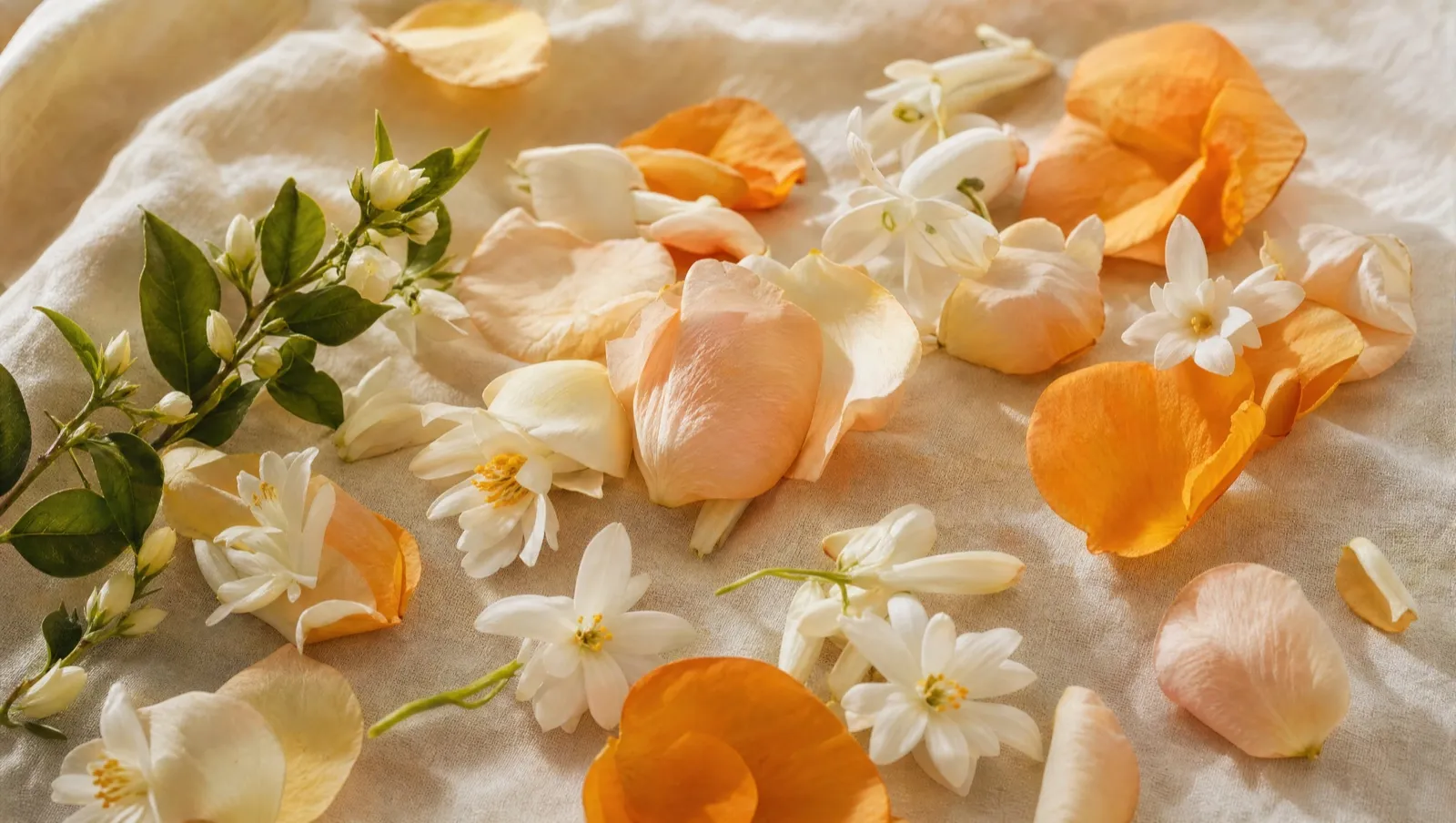
A floral perfume is one whose principal theme is a flower, such as rose, jasmine, violet, lilac, lily of the valley, narcissus or tuberose.[2]
The floral family
The technical department of the Société Française des Parfumeurs (SFP), a French perfumers’ society, drew up a classification of perfume families.[1] The Comité Français du Parfum published it.[1] In that classification, floral is the largest family.[2]
The family is split into 7 groups, from single-fragrance floral and floral bouquet to aldehydic floral and fruity woody floral.[3]
Within a perfume, floral notes are typically among the middle notes, with spicy and leather ones.[4] Middle notes give a perfume its character and last 3 to 4 hours on skin.[4]
Rose
The perfume industry uses 2 of the hundreds of known rose species.[5] Rosa centifolia, the May or Provence rose, is found in Grasse and Morocco.[5] Rosa damascena, the damask rose, is grown in Bulgaria and Turkey.[5]
In Grasse, centifolia is treated with volatile solvents to make a concrete and then an absolute.[5] Moroccan centifolia and Turkish damascena go through either solvent extraction or steam distillation, and distillation gives an essential oil.[5]
Enfleurage: flowers in cold fat
Enfleurage relies on the affinity between fragrance and fat, like maceration, but uses no heat.[6] That makes it suitable for fragile flowers such as jasmine or tuberose.[6] The petals are laid on a thin layer of fat spread over a sheet of glass.[7]
They stay 24 hours for jasmine and 72 hours for tuberose, then fresh flowers replace them until the fat is saturated.[8] The fat is rinsed in cold alcohol, and the alcohol is evaporated to leave a pomade absolute.[8]
Sources disagree on whether the method survives. Fabienne Pavia, writing in 1996, says only a select few in and around Grasse still use it.[9] A 2021 review in the journal Molecules says cold and hot enfleurage were abandoned because of their high costs.[10]
Solvent extraction: concrete and absolute
According to that review, solvent extraction replaced enfleurage, and it is the method used to prepare jasmine absolute.[10] Pavia defines a concrete as a solid or semi-solid substance taken from plants such as jasmine, rose or narcissus with volatile solvents such as hexane or benzene.[11] Once the solvent has absorbed the scent, it is evaporated off, leaving a dense paste: the concrete.[12]
The concrete is then rinsed in alcohol, frozen to between -12°C and -15°C, and filtered to remove its wax.[13] Evaporating the alcohol yields what perfumers simply call an absolute.[13]
Molecules that recreate flowers
Some flowers give no extract at all. Pavia writes that lily of the valley resists any form of distillation or extraction.[14] Perfumes replicate it instead with hydroxycitronellal, linalol and farnesol, she adds.[14]
Linalool exists in 2 forms: S-linalool has a pleasant floral scent, while R-linalool smells mainly of wood and lavender.[15] 2-Phenylethanol has a pleasant rose-like floral odour and can be isolated from rose essential oil.[16] For perfumery, it is synthesized or produced by microbial fermentation.[16]
Hedione was first used in Eau Sauvage, a citrus-fresh fragrance that Edmond Roudnitska created in 1966.[17][18] Pavia writes that Roudnitska could never have created Eau Sauvage without it.[18]
Perfume writer Denyse Beaulieu says there is a good chance that a jasmine note in a fragrance comes from a combination of chemicals rather than jasmine essence.[19] Blend benzyl acetate, hedione, jasmolactone and indole, she writes, and you get a decent impression of the flower that is a lot cheaper to produce.[19]
Indole and white flowers
In pure form, indole is a white crystalline solid with an offensive odour of faeces.[20] In high dilution it has a pleasant flower smell, and trace amounts occur in orange blossoms or jasmine.[20] Beaulieu writes that what makes orange blossom so enticing is the indole it shares with other white flowers, such as jasmine and tuberose.[21]
Questions
What flowers are used in floral perfumes?
In the classification of the Société Française des Parfumeurs, floral perfumes centre on a flower such as rose, jasmine, violet, lilac, lily of the valley, narcissus or tuberose. For rose, the perfume industry uses two species: Rosa centifolia and Rosa damascena.
How do perfumers get the scent out of flowers?
Volatile solvents such as hexane give a concrete, which is refined into an absolute; steam distillation gives an essential oil. Enfleurage, which captures fragile flowers like jasmine in cold fat, is rare or abandoned, depending on the source.
What is indole in white flowers?
Pure indole is a white crystalline solid with an offensive odour of faeces. In high dilution it has a pleasant flower smell, and trace amounts occur in orange blossoms or jasmine.
Sources
- The World of Perfume, Knickerbocker Press, 1996.
- The World of Perfume, Knickerbocker Press, 1996.
- The World of Perfume, Knickerbocker Press, 1996.
- Perfume and Flavor Engineering: A Chemical Engineering Perspective, Molecules (MDPI), 2021. DOI: 10.3390/molecules26113095.
- The World of Perfume, Knickerbocker Press, 1996.
- The World of Perfume, Knickerbocker Press, 1996.
- The World of Perfume, Knickerbocker Press, 1996.
- The World of Perfume, Knickerbocker Press, 1996.
- The World of Perfume, Knickerbocker Press, 1996.
- Fleeting Beauty—The World of Plant Fragrances and Their Application, Molecules (MDPI), 2021. DOI: 10.3390/molecules26092473.
- The World of Perfume, Knickerbocker Press, 1996.
- The World of Perfume, Knickerbocker Press, 1996.
- The World of Perfume, Knickerbocker Press, 1996.
- The World of Perfume, Knickerbocker Press, 1996.
- Fleeting Beauty—The World of Plant Fragrances and Their Application, Molecules (MDPI), 2021. DOI: 10.3390/molecules26092473.
- Fleeting Beauty—The World of Plant Fragrances and Their Application, Molecules (MDPI), 2021. DOI: 10.3390/molecules26092473.
- Perfumery: Practice and Principles, John Wiley & Sons, 1994.
- The World of Perfume, Knickerbocker Press, 1996.
- The Perfume Lover: A Personal History of Scent, St. Martin's Press, 2013.
- Fleeting Beauty—The World of Plant Fragrances and Their Application, Molecules (MDPI), 2021. DOI: 10.3390/molecules26092473.
- The Perfume Lover: A Personal History of Scent, St. Martin's Press, 2013.