
What makes a perfume woody?
A perfume is woody when wood materials carry it: warm notes such as sandalwood and patchouli, or dry notes such as cedar and vetiver. They come from heartwood, wood, roots and leaves. Synthetic molecules such as Iso E Super and Cedramber are also widely used, and most woody materials sit in the base.
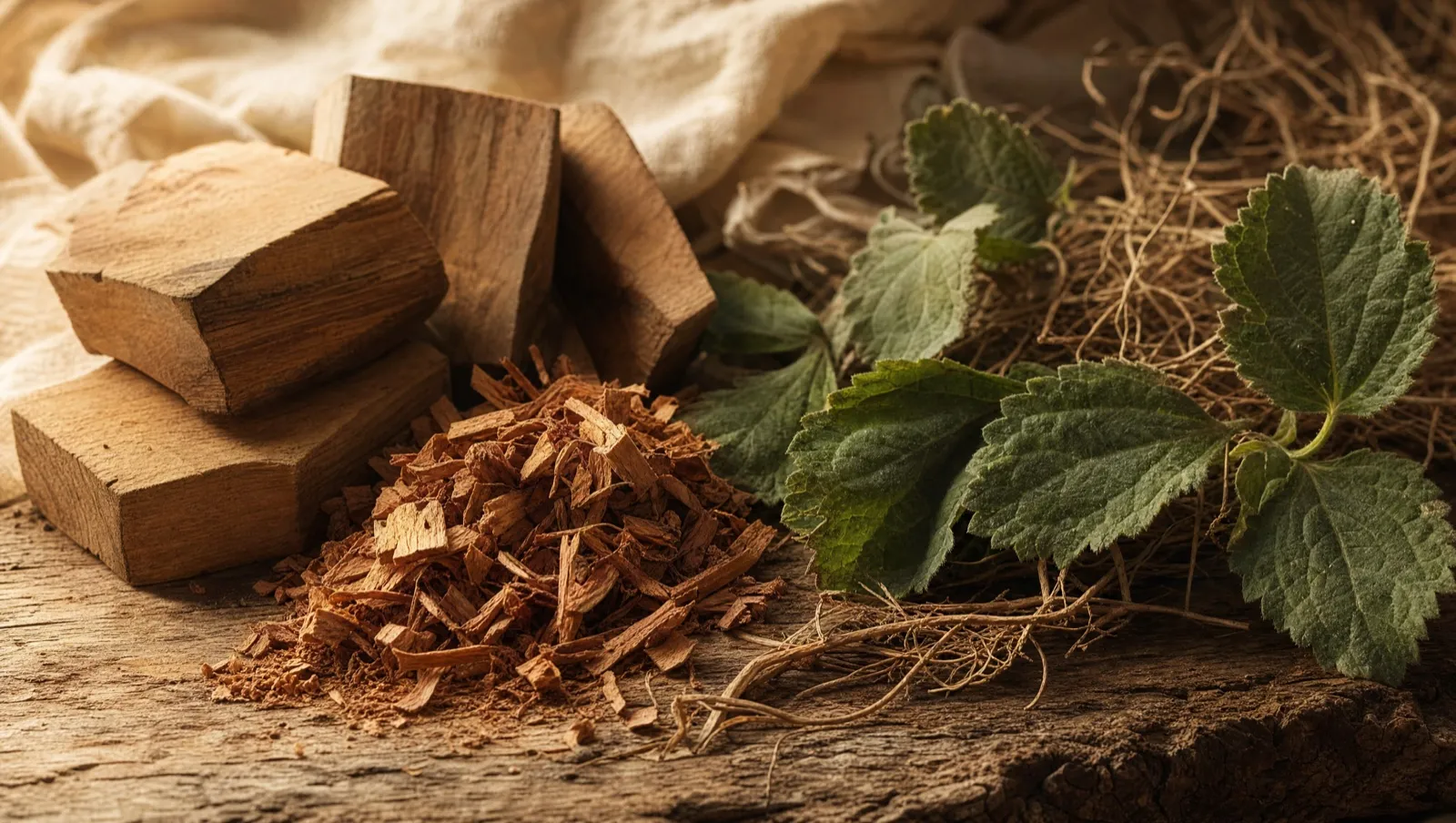
A perfume is woody when wood materials carry its character: warm notes such as sandalwood and patchouli, or dry notes such as cedar and vetiver.[2] Synthetic molecules such as Iso E Super are also widely used in perfumery.[31]
The woody family in perfume classification
Fabienne Pavia’s The World of Perfume (1996) reproduces the family classification of the Société Française des Parfumeurs (SFP).[1] In it, the woody family comprises perfumes with warm notes, such as sandalwood and patchouli, and dry notes, such as cedar and vetiver.[2] It has 6 subgroups: Woody, Citrus Conifer Woody, Aromatic Woody, Spicy Woody, Leather Spicy Woody and Oriental Woody.[3]
Elisabeth Barillé’s The Book of Perfume (1995) also names sandalwood, cedar, patchouli and vetiver as the usual sources of woody notes.[4] The book described the group in 1995 as dominated by men’s fragrances.[4]
Michael Edwards’s Fragrances of the World classification has a Woody Amber family.[7] It describes that family as spicy amber accords woven with wood notes of patchouli, oud and sandalwood.[6] The family covers the use of modern woody-amber ingredients.[7]
Robert Calkin counts most woody materials among the undisputed base notes.[5] A 2019 review in the Beilstein Journal of Organic Chemistry also lists wood among a perfume’s bottom notes.[35]
Where the woody materials come from
Sandalwood. Indian sandalwood, Santalum album, holds a prized essential oil in its heartwood.[11] Two compounds, Z-α-santalol and Z-β-santalol, are the most critical components of the oil’s fragrance.[14] The tree originates in India and is now extensively cultivated in South China, Sri Lanka, Indonesia, Malaysia, the Philippines and Northern Australia.[12]
Cedar. The cedarwood oil W. A. Poucher describes is distilled from the wood of Juniperus virginiana, a tree widely distributed in North America.[8] Atlas cedarwood oil comes from Cedrus atlantica, a close relative of the Lebanon cedar that grows in Northern Africa.[9]
Vetiver. Vetiver oil is distilled from the dried roots of a perennial grass, Chrysopogon zizanioides.[20] A 2021 paper in Angewandte Chemie says it appears in over a third of all fragrances.[19] One ketone is the key contributor to its transparent woody-ambery note, the same paper reports.[22]
The two papers on vetiver disagree on volume. The 2021 paper puts world consumption at an estimated 300 to 400 tonnes a year, 60% of it from Les Cayes in Haiti.[20] A 2022 paper in Molecules cites an estimated production of about 250 tonnes a year.[23]
Patchouli. Patchouli oil is distilled from the leaves of Pogostemon cablin, a plant from tropical Asia.[25][26] It is cultivated in the Caribbean, China, India, Indonesia and the Philippines.[25]
Sandalwood and sustainability
Excessive demand for Indian sandalwood led to the unsustainable exploitation of natural stands and a rapid rise in prices.[13] Its heartwood oil was priced at more than $5,000 per kilogram.[13] Santalum album is now listed as Vulnerable by the International Union for Conservation of Nature (IUCN).[15][17] A 2025 study reports that natural sandalwood is declining because of unsustainable harvesting.[18]
The authors of a 2022 Nature Communications paper call engineered microbes a promising alternative for producing plant compounds at scale.[15] They built a yeast that makes santalols in proportions very close to the international standard for the oil, ISO 3518:2002.[16] Engineered microbes can already produce patchouli scent by fermenting sugar, the Beilstein review reports.[34] The 2021 vetiver paper names biotechnological processes for patchouli (Clearwood) and sandalwood oil (Dreamwood), and says no industrially viable process exists for vetiver oil.[21] Reaching vetiver’s oil-filled roots is cumbersome and land-damaging, according to the 2022 Molecules paper.[24]
Synthetic molecules
Iso E Super was first named Isocyclemone E and later renamed.[27] Chemists make it from myrcene, which industry obtains from turpentine.[28][29] The Beilstein review lists its odour as woody, floral, ambergris, violet, old-wood and lemony.[30] A minor impurity of about 5%, now called Iso E Super Plus, was held responsible for its characteristic smell.[32]
Christian Dior’s Fahrenheit contains 25% Iso E Super, Lancôme’s Trésor 18% and Shiseido’s Féminité du Bois 43%, the review reports.[33]
Cedramber is methyl cedryl ether, made by methylating cedrol.[10] Cedrol makes up about 19% of Texas cedarwood oil and 15.8% of Virginia cedarwood oil.[10] A 2023 paper places its character between amber and patchouli and says perfumes are among its uses.[10]
Questions
What makes a perfume woody?
In the classification of the Société Française des Parfumeurs (SFP), the woody family comprises perfumes with warm notes, such as sandalwood and patchouli, and dry notes, such as cedar and vetiver.
Is sandalwood endangered?
Indian sandalwood, Santalum album, is listed as Vulnerable by the International Union for Conservation of Nature (IUCN) because of overexploitation. Natural sandalwood is declining from unsustainable harvesting, and the tree is now extensively cultivated in South China, Sri Lanka, Indonesia, Malaysia, the Philippines and Northern Australia.
What is Iso E Super?
A synthetic ingredient made from myrcene, first named Isocyclemone E and later renamed. Its odour is described as woody, floral, ambergris, violet, old-wood and lemony. Christian Dior's Fahrenheit contains 25% Iso E Super.
Sources
- The World of Perfume, Knickerbocker Press, 1996.
- The World of Perfume, Knickerbocker Press, 1996.
- The World of Perfume, Knickerbocker Press, 1996.
- The Book of Perfume, Flammarion, 1995.
- Perfumery: Practice and Principles, John Wiley & Sons, 1994.
- From Oriental, to Amber: Why it was time to rename the Oriental fragrance families, Retail Beauty (Fragrances of the World), 2021.
- From Oriental, to Amber: Why it was time to rename the Oriental fragrance families, Retail Beauty (Fragrances of the World), 2021.
- Perfumes, Cosmetics and Soaps, Vol. 1: The Raw Materials of Perfumery, Chapman and Hall, 1979.
- Perfumes, Cosmetics and Soaps, Vol. 1: The Raw Materials of Perfumery, Chapman and Hall, 1979.
- Dietary Supplementation of Methyl Cedryl Ether Ameliorates Adiposity in High-Fat Diet-Fed Mice, Nutrients (MDPI), 2023. DOI: 10.3390/nu15030788.
- Improved chromosome-level genome assembly of Indian sandalwood (Santalum album), Scientific Data, 2023. DOI: 10.1038/s41597-023-02849-x.
- Improved chromosome-level genome assembly of Indian sandalwood (Santalum album), Scientific Data, 2023. DOI: 10.1038/s41597-023-02849-x.
- Improved chromosome-level genome assembly of Indian sandalwood (Santalum album), Scientific Data, 2023. DOI: 10.1038/s41597-023-02849-x.
- Rationally engineering santalene synthase to readjust the component ratio of sandalwood oil, Nature Communications, 2022. DOI: 10.1038/s41467-022-30294-8.
- Rationally engineering santalene synthase to readjust the component ratio of sandalwood oil, Nature Communications, 2022. DOI: 10.1038/s41467-022-30294-8.
- Rationally engineering santalene synthase to readjust the component ratio of sandalwood oil, Nature Communications, 2022. DOI: 10.1038/s41467-022-30294-8.
- Growth Performance of Sandalwood (Santalum album) Plant in Western Nepal, The Scientific World Journal, 2025. DOI: 10.1155/tswj/3052342.
- Growth Performance of Sandalwood (Santalum album) Plant in Western Nepal, The Scientific World Journal, 2025. DOI: 10.1155/tswj/3052342.
- The Smelling Principle of Vetiver Oil, Unveiled by Chemical Synthesis, Angewandte Chemie International Edition, 2021. DOI: 10.1002/anie.202014609.
- The Smelling Principle of Vetiver Oil, Unveiled by Chemical Synthesis, Angewandte Chemie International Edition, 2021. DOI: 10.1002/anie.202014609.
- The Smelling Principle of Vetiver Oil, Unveiled by Chemical Synthesis, Angewandte Chemie International Edition, 2021. DOI: 10.1002/anie.202014609.
- The Smelling Principle of Vetiver Oil, Unveiled by Chemical Synthesis, Angewandte Chemie International Edition, 2021. DOI: 10.1002/anie.202014609.
- Evaluation of Vetiver Volatile Compound Production under Aeroponic-Grown Conditions for the Perfume Industry, Molecules (MDPI), 2022. DOI: 10.3390/molecules27061942.
- Evaluation of Vetiver Volatile Compound Production under Aeroponic-Grown Conditions for the Perfume Industry, Molecules (MDPI), 2022. DOI: 10.3390/molecules27061942.
- The Flow Rate of the Condenser Cooling Water in the Distillation Process Increases the Quality and Quantity of Patchouli Oil, The Scientific World Journal, 2024. DOI: 10.1155/2024/9844242.
- The Flow Rate of the Condenser Cooling Water in the Distillation Process Increases the Quality and Quantity of Patchouli Oil, The Scientific World Journal, 2024. DOI: 10.1155/2024/9844242.
- Synthetic terpenoids in the world of fragrances: Iso E Super® is the showcase, Beilstein Journal of Organic Chemistry, 2019. DOI: 10.3762/bjoc.15.252.
- Synthetic terpenoids in the world of fragrances: Iso E Super® is the showcase, Beilstein Journal of Organic Chemistry, 2019. DOI: 10.3762/bjoc.15.252.
- Synthetic terpenoids in the world of fragrances: Iso E Super® is the showcase, Beilstein Journal of Organic Chemistry, 2019. DOI: 10.3762/bjoc.15.252.
- Synthetic terpenoids in the world of fragrances: Iso E Super® is the showcase, Beilstein Journal of Organic Chemistry, 2019. DOI: 10.3762/bjoc.15.252.
- Synthetic terpenoids in the world of fragrances: Iso E Super® is the showcase, Beilstein Journal of Organic Chemistry, 2019. DOI: 10.3762/bjoc.15.252.
- Synthetic terpenoids in the world of fragrances: Iso E Super® is the showcase, Beilstein Journal of Organic Chemistry, 2019. DOI: 10.3762/bjoc.15.252.
- Synthetic terpenoids in the world of fragrances: Iso E Super® is the showcase, Beilstein Journal of Organic Chemistry, 2019. DOI: 10.3762/bjoc.15.252.
- Synthetic terpenoids in the world of fragrances: Iso E Super® is the showcase, Beilstein Journal of Organic Chemistry, 2019. DOI: 10.3762/bjoc.15.252.
- Synthetic terpenoids in the world of fragrances: Iso E Super® is the showcase, Beilstein Journal of Organic Chemistry, 2019. DOI: 10.3762/bjoc.15.252.