
What is a gourmand perfume?
A gourmand perfume evokes the smell of food. Nigel Groom describes the gourmand note as evoking a tempting smell of food, such as vanilla, ripe fruit, caramel, honey or chocolate. Karen Gilbert names Thierry Mugler's Angel, from 1992, as an example of the gourmand trend, bringing memories of childhood, with chocolate and cotton candy.
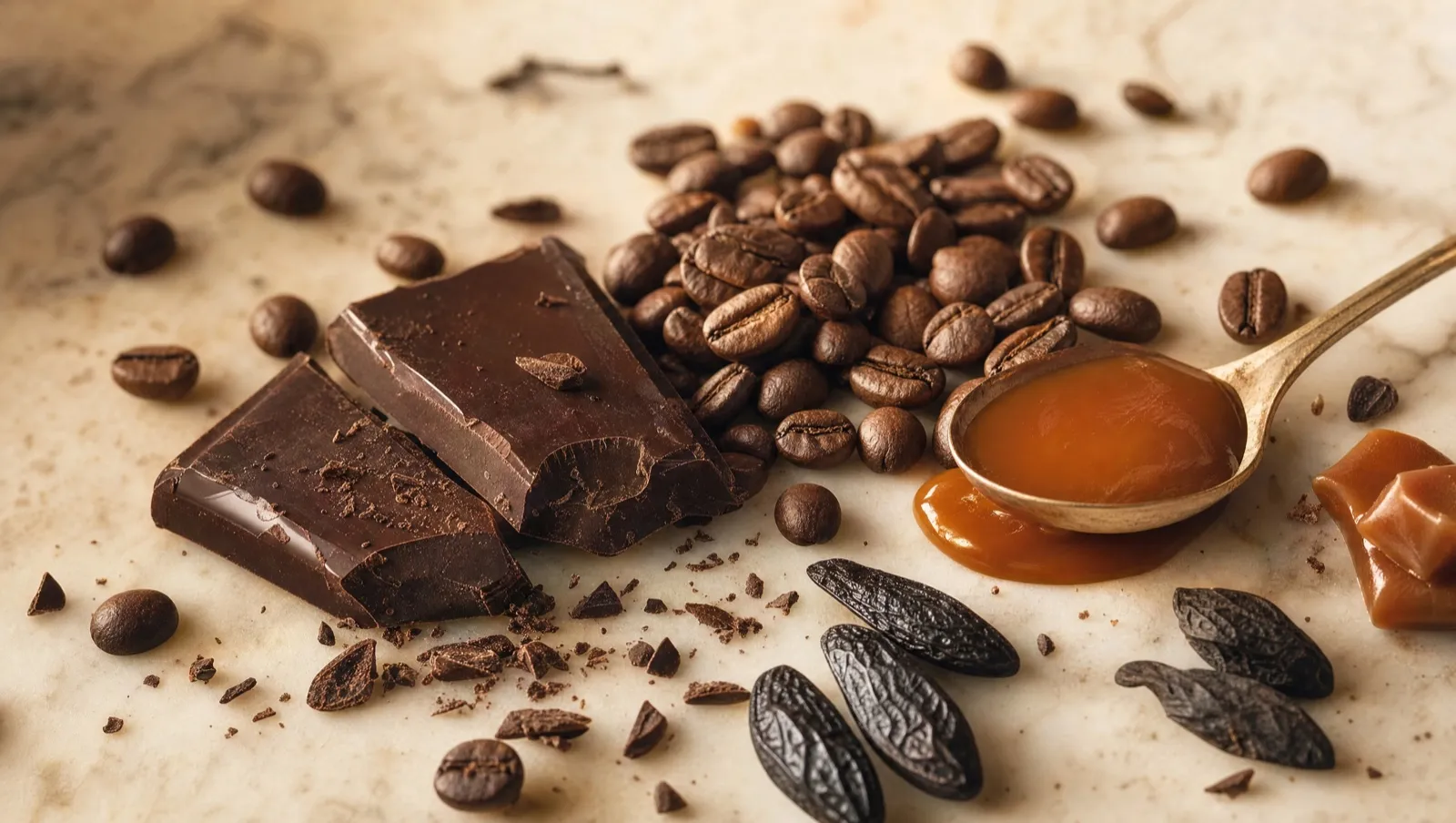
A gourmand note evokes a tempting smell of food, such as vanilla, ripe fruit, caramel, honey or chocolate.[1] It is also sometimes called an edible note.[1]
Notes that smell like food
Nigel Groom’s New Perfume Handbook defines the gourmand note by what it evokes: a tempting smell of food.[1] His examples run from vanilla and ripe fruit to caramel, honey and chocolate.[1]
Vanilla is part of the gourmand family in perfumery.[7] Its story, from orchid pod to vanillin, has its own page: vanilla in perfume.
Angel, 1992
In her book on the art and craft of fragrance, Karen Gilbert describes the gourmand as a prevailing trend.[2] Her example is Thierry Mugler’s Angel, from 1992.[2] She writes that Angel brought memories of childhood into fragrance, with chocolate, cotton candy and fairground rides, and she calls fragrances like it polarizing.[2]
In The Perfect Scent, Chandler Burr writes that the perfumer Olivier Cresp created Angel.[3] Burr describes its formula as two sweet scents side by side.[4] One is marzipan, made with a synthetic molecule called coumarin, and the other is cotton candy, made with ethyl maltol.[4] Burr adds that ethyl maltol is the molecule you taste when you eat cotton candy.[4] In his account, that pair alone would be a confection, but Cresp added a huge dose of natural patchouli.[5]
The molecules behind the sweetness
Ethyl maltol smells of caramel.[6] A 2026 paper in i-Perception reports that, combined with ethyl isobutyrate, which smells of strawberry, ethyl maltol gives the perception of pineapple, in humans and in several other species.[6]
Coumarin has a sweet, slightly spicy, hay-like scent.[8] Its sweet odor is often compared to fresh hay, woodruff or vanilla.[13] The name comes from coumarou, a French term for the tonka bean, from which Vogel first isolated coumarin in 1820.[12] Perkin first synthesized coumarin in 1868.[10]
Where the sweetness sits in a perfume
An odorant can be placed in the note pyramid by its substantivity, which is how perceptible it is on a paper strip.[15] A top note lasts up to a few hours on the strip, a middle note many hours, and a base note days up to weeks.[15]
Warm and sweet odorants such as vanillin are typically base notes.[11] Coumarin is often considered a base note, but higher doses can bring it into the middle notes.[9] If you want to see how top, heart and base notes work, read top, heart and base notes.
Vanilla also turns up in amber notes: an amber note is usually built from labdanum combined with styrax, vanilla, civet or benzoin.[14] That family has its own page: what amber means in perfume.
Questions
What notes are in a gourmand perfume?
Notes that evoke a tempting smell of food. Nigel Groom's New Perfume Handbook gives vanilla, ripe fruit, caramel, honey and chocolate as examples, and says the gourmand note is also sometimes called an edible note.
Is vanilla a gourmand note?
Yes. Vanilla is part of the gourmand family in perfumery, and Groom includes it among the foods a gourmand note evokes.
Is Angel by Thierry Mugler a gourmand perfume?
Karen Gilbert gives Angel, from 1992, as an example of the gourmand trend, bringing memories of childhood, with chocolate, cotton candy and fairground rides, into fragrance. Chandler Burr writes that its formula pairs marzipan, made with coumarin, and cotton candy, made with ethyl maltol.
Sources
- The New Perfume Handbook, Blackie Academic & Professional, 1997.
- Perfume: The Art and Craft of Fragrance, CICO Books, 2013.
- The Perfect Scent: A Year Inside the Perfume Industry in Paris and New York, Henry Holt, 2008.
- The Perfect Scent: A Year Inside the Perfume Industry in Paris and New York, Henry Holt, 2008.
- The Perfect Scent: A Year Inside the Perfume Industry in Paris and New York, Henry Holt, 2008.
- 'Play the fragrance': Designing musical soundscapes to match fragrances based on olfactory-auditory crossmodal correspondences, i-Perception, 2026. DOI: 10.1177/20416695251409265.
- Hierarchies of smell: structuring the molecular odor space using semantic taxonomies and machine learning, Chemical Senses, 2026. DOI: 10.1093/chemse/bjag020.
- Synthesis of odorants in flow and their applications in perfumery, Beilstein Journal of Organic Chemistry, 2022. DOI: 10.3762/bjoc.18.76.
- Synthesis of odorants in flow and their applications in perfumery, Beilstein Journal of Organic Chemistry, 2022. DOI: 10.3762/bjoc.18.76.
- Synthesis of odorants in flow and their applications in perfumery, Beilstein Journal of Organic Chemistry, 2022. DOI: 10.3762/bjoc.18.76.
- Synthesis of odorants in flow and their applications in perfumery, Beilstein Journal of Organic Chemistry, 2022. DOI: 10.3762/bjoc.18.76.
- Coumarins in Food and Methods of Their Determination, Foods (MDPI), 2020. DOI: 10.3390/foods9050645.
- Coumarins in Food and Methods of Their Determination, Foods (MDPI), 2020. DOI: 10.3390/foods9050645.
- Essence and Alchemy: A Book of Perfume, North Point Press, 2001.
- Synthesis of odorants in flow and their applications in perfumery, Beilstein Journal of Organic Chemistry, 2022. DOI: 10.3762/bjoc.18.76.