
Japanese perfume culture: kōdō, agarwood and Shiseido
Incense wood was first recorded in Japan in 595, and kōdō, the "way of the fragrance", is the art of appreciating Japanese incense. Shiseido, whose timeline starts with a Western-style pharmacy in 1872, dates its first perfume, Hanatsubaki, to 1917. In 2019 BeautyMatter, citing Euromonitor, reported that Japan remains the smallest fragrance market in the world.
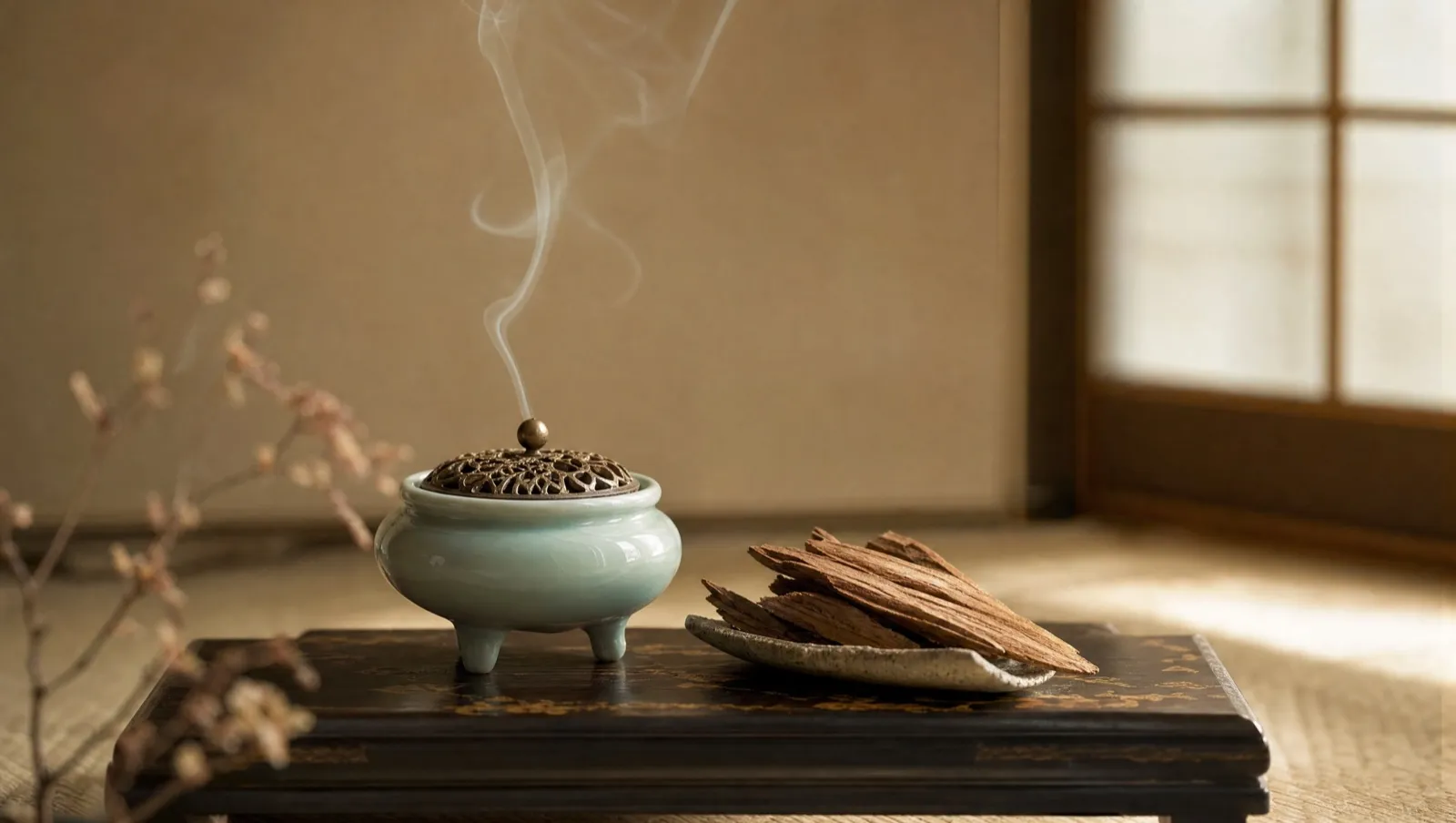
Incense wood was recorded for the first time in Japan in 595, during the reign of Empress Suiko.[1] Buddhism had reached Japan from the continent in the mid-sixth century, and incense and its implements came with it.[1]
Incense at court
From the end of the Nara period, courtiers began to burn incense in their homes.[2] They kneaded it into balls that perfumed rooms, clothes and hair.[2]
In incense awase, competitors compared and judged two takimono, small balls of pulverized incense materials glued together with resin.[11] The “Umegae” chapter of The Tale of Genji describes one such contest.[11]
Kōdō, the way of incense
Japan Up Close translates kōdō as the “way of the fragrance” and calls it the art of appreciating Japanese incense.[7] It places kōdō among the major classical arts, alongside the tea ceremony and ikebana flower arrangement.[7]
Through Zen, a new way of appreciating incense developed among aristocratic warriors, who used the incense woods themselves instead of kneaded mixtures.[3] In the Muromachi period, the etiquette of the way of incense developed in tandem with the tea ceremony.[4] Incense gatherings of that period focused mainly on poetry, especially poetry that sought a fitting name for a given scent, and kōdō evolved out of that effort.[12]
Japan Up Close names two of its founders: Sanetaka Sanjonishi, a court noble, and Soushin Shino, a samurai who had studied jinkoh (aloeswood) under the shogun Yoshimasa Ashikaga.[8]
By the start of the Edo period, kōdō was practiced mainly as kumikō, incense games.[13] A collection from 1737, Kōdō ran no sono, describes more than 200 of them.[13]
How a kōdō gathering works
Participants sit in the formal seiza position and take turns guessing a fragrance prepared by the komoto, the person who burns the incense.[9] The wood rests on a mica plate above smouldering coals, so it gives off a subtle fragrance without burning.[9] Following Buddhist tradition, the verb for perceiving the scent is “to listen” (kiku), not “to smell”.[14]
After the Meiji reforms of 1867–68, the practice of incense became passé.[5] From the 1890s, appreciation of the way of incense was gradually reborn.[6] In 2000, TRAFFIC reported that a revival of Koh doh, the incense ceremony, had revitalised interest in agarwood in Japan.[16]
Agarwood and other fragrant woods
Aloeswood is one of several names for agarwood, the fragrant heartwood that is also called oud.[17] Japan Up Close says kōdō divides its fragrances into rikkoku gomi: six kinds of fragrant wood, including kyara, and five tastes, namely sweet, bitter, spicy-hot, sour and salty.[10]
According to TRAFFIC, most of the highest-grade Japanese incense uses natural raw materials, including ground agarwood extracts combined with sandalwood, benzoin and other ingredients, then moulded and baked.[15] Pure agarwood is also burned as incense in Japan.[15]
Shiseido and Western-style perfume
Shiseido’s own timeline starts in 1872 with what it calls the very first Western-style pharmacy in Ginza, Tokyo.[18] Its corporate museum dates the company’s first perfume, Hanatsubaki, to 1917.[19] It was created in the image of the camellia, a flower with little distinct fragrance of its own.[19]
Kiku, from around 1920, was formulated on natural chrysanthemum blossoms.[20] Angelic, from 1991, was blended by the French perfumer Jean-Louis Sieuzac.[21]
A small market for perfume
In 2019, BeautyMatter cited Euromonitor International data showing that Japan has the highest per-capita spending on skincare and cosmetics, yet remains the smallest fragrance market in the world.[22] Fragrance made up only 1.2% of the Japanese beauty market in 2016.[22] Kelly Kovack wrote in BeautyMatter that light, clean, dry, understated scents are the preference.[23]
Benjamin Peter, general manager of Style & Scents Global, told Personal Care Insights in 2025 that Japan is a new frontier for the company.[24] The magazine reported that the company’s market research found light and fresh scents the most popular in Japan.[25]
Caroline Moulin wrote in Premium Beauty News in 2025 that the Japanese perfume market grew 7.7% in 2024 but still lags far behind skincare.[26] Moulin also writes that preferences are shifting from soft floral and citrus scents to ambery, musky and leathery notes, often with local ingredients such as yuzu and hinoki.[27]
Questions
What is kōdō?
Japan Up Close translates kōdō as the "way of the fragrance" and calls it the art of appreciating Japanese incense. Participants take turns guessing a fragrance prepared by the komoto. The wood rests on a mica plate over smouldering coals, so it gives off a subtle fragrance without burning. Following Buddhist tradition, the verb for perceiving the scent is "to listen" (kiku), not "to smell".
What wood is used in kōdō?
Japan Up Close says Soushin Shino, one of the founders of kōdō, studied jinkoh (aloeswood), and it lists six kinds of fragrant wood, including kyara. Aloeswood is one of several names for agarwood, which is also called oud.
Do Japanese people prefer light perfumes?
Trade press reports say so. In 2019 Kelly Kovack wrote in BeautyMatter that light, clean, dry, understated scents are the preference. In 2025 Personal Care Insights reported that Style & Scents Global's market research found light and fresh scents the most popular in Japan.
Sources
- Japanese Incense (Heilbrunn Timeline of Art History), The Metropolitan Museum of Art, 2009.
- Japanese Incense (Heilbrunn Timeline of Art History), The Metropolitan Museum of Art, 2009.
- Japanese Incense (Heilbrunn Timeline of Art History), The Metropolitan Museum of Art, 2009.
- Japanese Incense (Heilbrunn Timeline of Art History), The Metropolitan Museum of Art, 2009.
- Japanese Incense (Heilbrunn Timeline of Art History), The Metropolitan Museum of Art, 2009.
- Japanese Incense (Heilbrunn Timeline of Art History), The Metropolitan Museum of Art, 2009.
- Kodo - The Way of Fragrance, Japan Up Close, 2023.
- Kodo - The Way of Fragrance, Japan Up Close, 2023.
- Kodo - The Way of Fragrance, Japan Up Close, 2023.
- Kodo - The Way of Fragrance, Japan Up Close, 2023.
- Scenting as Performance: Aesthetics of Aroma and Sensory Imagination in the Incense Ceremony, Proceedings of the Association for Japanese Literary Studies, 2016.
- Scenting as Performance: Aesthetics of Aroma and Sensory Imagination in the Incense Ceremony, Proceedings of the Association for Japanese Literary Studies, 2016.
- Scenting as Performance: Aesthetics of Aroma and Sensory Imagination in the Incense Ceremony, Proceedings of the Association for Japanese Literary Studies, 2016.
- Scenting as Performance: Aesthetics of Aroma and Sensory Imagination in the Incense Ceremony, Proceedings of the Association for Japanese Literary Studies, 2016.
- Heart of the Matter: Agarwood Use and Trade and CITES Implementation for Aquilaria malaccensis, TRAFFIC International, 2000.
- Heart of the Matter: Agarwood Use and Trade and CITES Implementation for Aquilaria malaccensis, TRAFFIC International, 2000.
- Agarwood—The Fragrant Molecules of a Wounded Tree, Molecules (MDPI), 2022. DOI: 10.3390/molecules27113386.
- About us: history, Shiseido.
- Products: Introducing the Collection, Shiseido Corporate Museum.
- Products: Introducing the Collection, Shiseido Corporate Museum.
- Products: Introducing the Collection, Shiseido Corporate Museum.
- The Cultural Relationship with Fragrance in Japan, BeautyMatter, 2019.
- The Cultural Relationship with Fragrance in Japan, BeautyMatter, 2019.
- COSME Tokyo 2025 live: International scents for the Japanese market, Personal Care Insights, 2025.
- COSME Tokyo 2025 live: International scents for the Japanese market, Personal Care Insights, 2025.
- Japan and fragrance: what would happen if the two finally meet?, Premium Beauty News, 2025.
- Japan and fragrance: what would happen if the two finally meet?, Premium Beauty News, 2025.