
Citrus perfume: what it is and why it fades fast
A citrus perfume belongs to the family in which citrus essential oils dominate, often lemon, orange, bergamot or mandarin. It fades fast because citrus notes are top notes, usually the most volatile part of a perfume: they tend to evaporate quickly and typically last 15 to 30 minutes on skin.
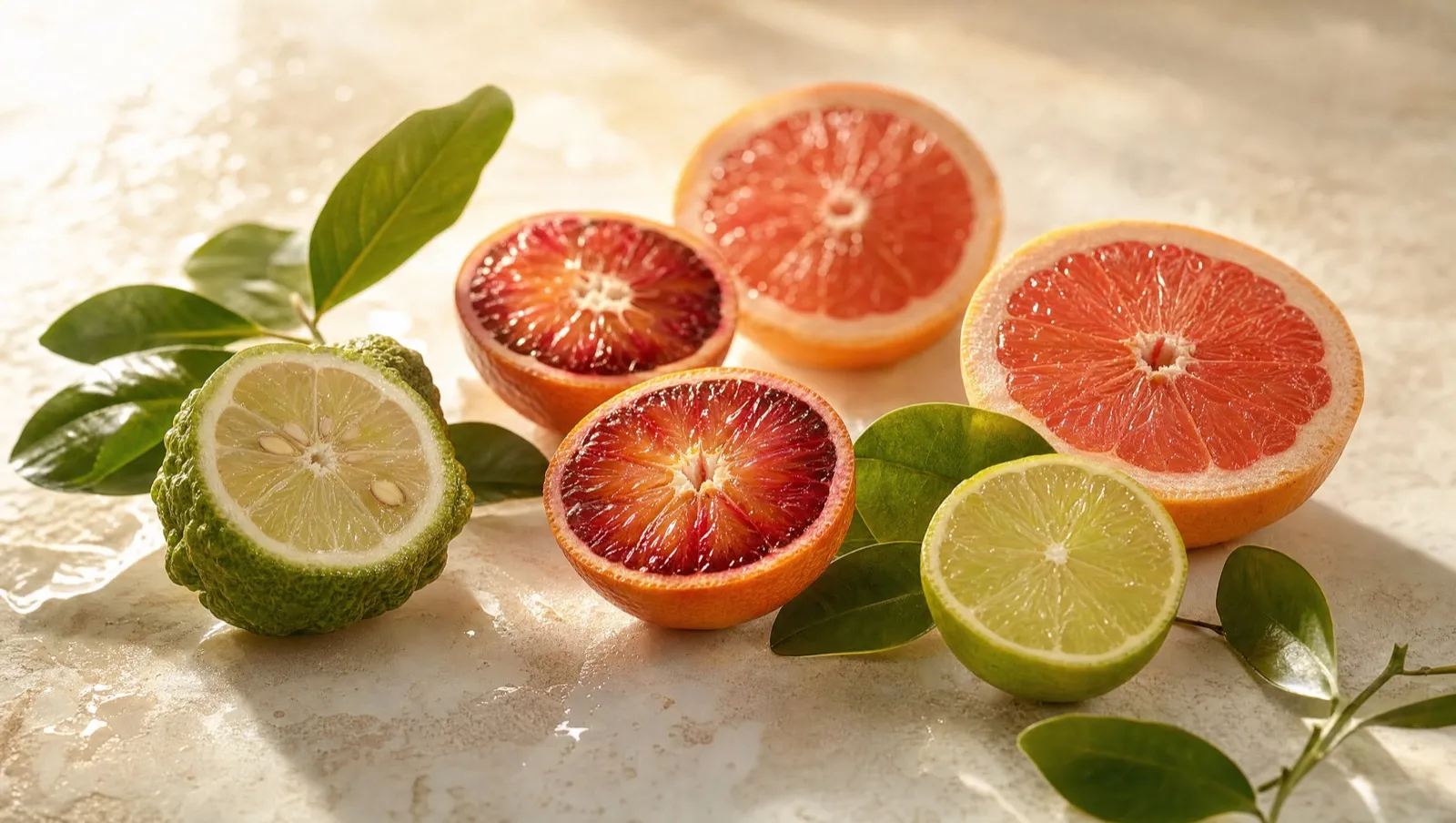
A citrus perfume belongs to the family in which citrus essential oils dominate.[1] They are often based on lemon, orange, bergamot or mandarin, and eau de cologne belongs to the family.[2]
Where citrus sits among perfume families
Several classifications coexist, but French usage most often counts 7 perfume families, and citrus is one of them, under the name hespéridés.[3] The others are amber (or oriental), woody, chypre, leather, floral and fougère.[3]
Edwards’s classification differs: it groups citrus, green, watery and fruity scents into a fresh family, and classifies 12% of fragrances in those categories.[5] Citrus is then one of 4 fresh subfamilies, with green, water and fruity.[4]
The raw materials
Citrus peel oil comes from the rind, which is rich in compounds of interest to the perfume industry.[10] A 2019 review covered the 10 most studied species, among them sweet orange, mandarin, grapefruit, lemon, lime, bitter orange, bergamot and yuzu.[10]
In these rind oils, limonene is always the most abundant compound, usually about 60% to 95% of the oil.[11] Bergamot stands apart: its linalyl acetate is sometimes almost as abundant as limonene, which the review did not find in any other species.[12]
Michele Navarra and colleagues describe bergamot oil as one of the main basic constituents in the manufacture of perfumes.[16]
How the oil is pressed from the peel
The outer, coloured layer of the peel, called the flavedo, is rich in oil glands.[20] Bergamot oil is obtained by rasping and cold pressing the fruit peel.[15] Cold pressing works for citrus peel but should not be used for citrus flowers and leaves.[13]
Pressing is a mechanical method, and for mandarin oil it helps preserve heat-sensitive volatile compounds and the characteristic aroma.[21]
Why citrus notes fade fast
A perfume opens with its top notes, which typically include citrus and last 15 to 30 minutes on skin.[9] Middle notes last 3 to 4 hours, and base notes such as amber or musk more than 4 hours.[9]
The top note usually consists of the most volatile part of the composition.[7] Perfumers know that citrus and green notes tend to evaporate quickly, while oriental, powdery and animalic scents are tenacious.[6]
Staying power on skin has a name: substantivity, or tenacity.[26] In a 2013 analysis, the correlation between how fresh a material smells and its substantivity was quite strong, at r = −0.85.[8]
Bergamot, sunlight and the rules
Bergamot oil has a non-volatile fraction, 4% to 7% of the total, that includes bergapten, also called 5-methoxypsoralen, at about 0.2%.[17] Bergapten and other furocoumarins in the oil may cause phototoxic effects on sun-exposed skin.[18]
A 2019 review found phototoxic furocoumarins of the bergapten type in cold-pressed bitter orange, lime and, above all, bergamot peel oil.[14] Its authors write that such oil cannot be used in pharmaceutical or cosmetic products.[14]
In its 48th Amendment, the International Fragrance Association (IFRA) limits expressed bergamot oil to 0.4% in products for skin exposed to sunshine.[22] Soaps, bath products and others that are washed off the skin are excluded.[22] A second IFRA standard recommends keeping total bergapten in those products under 0.0015%, or 15 ppm.[23] It also covers expressed bitter orange, grapefruit and lime oil, and cold-pressed lemon oil.[24]
EU cosmetics law lists furocoumarins among prohibited substances, except for their normal content in natural essences.[25] In sun protection and bronzing products, they must stay below 1 mg/kg.[25]
Perfumers have another option: a furocoumarin-free bergamot oil, prepared for perfumery and cosmetics.[19] Vacuum distillation of the peel gives an oil without bergapten that is chemically comparable to the cold-pressed oil.[19]
Questions
Why do citrus perfumes fade so fast?
Citrus notes are top notes, which usually make up the most volatile part of a perfume. Citrus and green notes tend to evaporate quickly, and top notes typically last 15 to 30 minutes on skin.
What is a hesperidic perfume?
Hespéridé is the French term for a perfume of the family in which citrus essential oils dominate. Hespéridés are often based on lemon, orange, bergamot or mandarin, and eaux de Cologne belong to the family.
Can bergamot in perfume cause a skin reaction in the sun?
Bergamot oil contains bergapten and other furocoumarins, which may cause phototoxic effects on sun-exposed skin. IFRA limits expressed bergamot oil to 0.4% in products left on skin exposed to sunshine, and a furocoumarin-free bergamot oil has been prepared for perfumery.
Sources
- hespéridé (Grand dictionnaire terminologique), Office québécois de la langue française, 2019.
- hespéridé (Grand dictionnaire terminologique), Office québécois de la langue française, 2019.
- hespéridé (Grand dictionnaire terminologique), Office québécois de la langue française, 2019.
- What is a Fresh Scent in Perfumery? Perceptual Freshness is Correlated with Substantivity, Sensors (MDPI), 2013. DOI: 10.3390/s130100463.
- What is a Fresh Scent in Perfumery? Perceptual Freshness is Correlated with Substantivity, Sensors (MDPI), 2013. DOI: 10.3390/s130100463.
- What is a Fresh Scent in Perfumery? Perceptual Freshness is Correlated with Substantivity, Sensors (MDPI), 2013. DOI: 10.3390/s130100463.
- What is a Fresh Scent in Perfumery? Perceptual Freshness is Correlated with Substantivity, Sensors (MDPI), 2013. DOI: 10.3390/s130100463.
- What is a Fresh Scent in Perfumery? Perceptual Freshness is Correlated with Substantivity, Sensors (MDPI), 2013. DOI: 10.3390/s130100463.
- Perfume and Flavor Engineering: A Chemical Engineering Perspective, Molecules (MDPI), 2021. DOI: 10.3390/molecules26113095.
- Volatile Compounds in Citrus Essential Oils: A Comprehensive Review, Frontiers in Plant Science, 2019. DOI: 10.3389/fpls.2019.00012.
- Volatile Compounds in Citrus Essential Oils: A Comprehensive Review, Frontiers in Plant Science, 2019. DOI: 10.3389/fpls.2019.00012.
- Volatile Compounds in Citrus Essential Oils: A Comprehensive Review, Frontiers in Plant Science, 2019. DOI: 10.3389/fpls.2019.00012.
- Volatile Compounds in Citrus Essential Oils: A Comprehensive Review, Frontiers in Plant Science, 2019. DOI: 10.3389/fpls.2019.00012.
- Volatile Compounds in Citrus Essential Oils: A Comprehensive Review, Frontiers in Plant Science, 2019. DOI: 10.3389/fpls.2019.00012.
- Citrus bergamia essential oil: from basic research to clinical application, Frontiers in Pharmacology, 2015. DOI: 10.3389/fphar.2015.00036.
- Citrus bergamia essential oil: from basic research to clinical application, Frontiers in Pharmacology, 2015. DOI: 10.3389/fphar.2015.00036.
- Citrus bergamia essential oil: from basic research to clinical application, Frontiers in Pharmacology, 2015. DOI: 10.3389/fphar.2015.00036.
- Citrus bergamia essential oil: from basic research to clinical application, Frontiers in Pharmacology, 2015. DOI: 10.3389/fphar.2015.00036.
- Citrus bergamia essential oil: from basic research to clinical application, Frontiers in Pharmacology, 2015. DOI: 10.3389/fphar.2015.00036.
- Green Recovery of Bioactive Compounds from Bergamot (Citrus bergamia) By-Products: Sustainable Extraction, Food Applications, and Health-Promoting Properties, Foods (MDPI), 2026. DOI: 10.3390/foods15111955.
- Citrus reticulata Essential Oil as a Bioactive Food Ingredient: Composition Variability, Extraction, Functional Bioactivities, and Cross-Study Quantitative Analysis, Food Science & Nutrition, 2026. DOI: 10.1002/fsn3.72380.
- IFRA Standard: Bergamot oil expressed (48th Amendment), International Fragrance Association (IFRA), 2015.
- IFRA Standard: Citrus oils and other furocoumarins containing essential oils (48th Amendment), International Fragrance Association (IFRA), 2015.
- IFRA Standard: Citrus oils and other furocoumarins containing essential oils (48th Amendment), International Fragrance Association (IFRA), 2015.
- Regulation (EC) No 1223/2009 on cosmetic products, Annex II: list of substances prohibited in cosmetic products (consolidated text of 1 May 2025), EUR-Lex (European Union), 2025.
- What is a Fresh Scent in Perfumery? Perceptual Freshness is Correlated with Substantivity, Sensors (MDPI), 2013. DOI: 10.3390/s130100463.